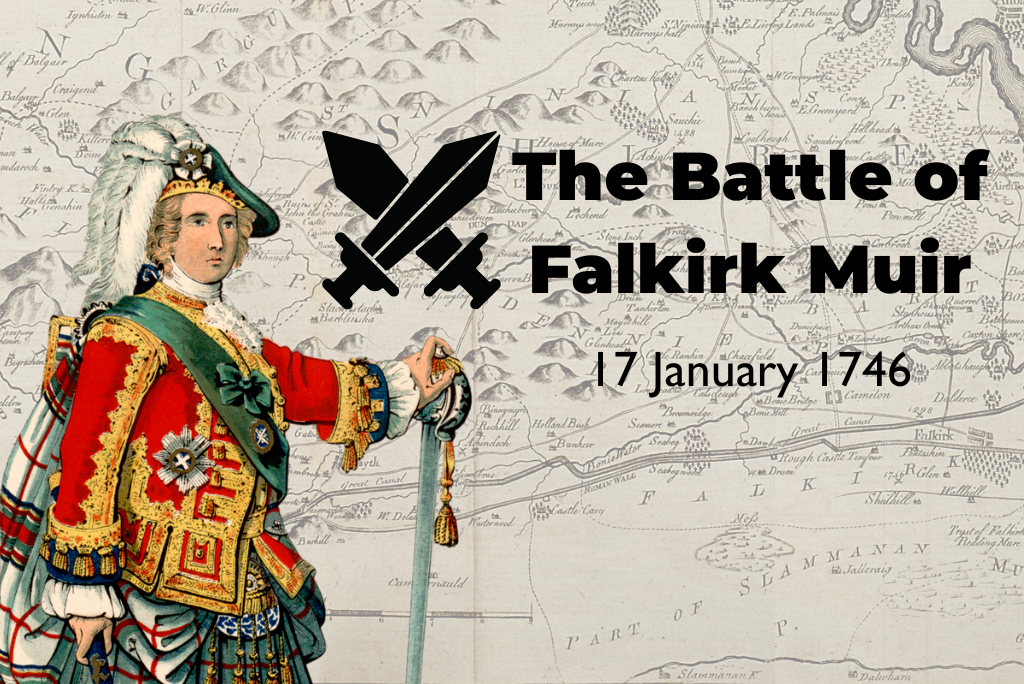
On bleak moorland in atrocious weather during the depths of the Scottish winter, a makeshift Jacobite Army of some seven thousand men under the command of Prince Charles Edward Stuart decisively defeated General Henry Hawley’s much larger and better equipped professional Government Army. How was victory achieved at the Battle of Falkirk Muir? And why, having routed the redcoats, was Prince Charlie’s army then annihilated at Culloden just three months later?
The Jacobite Plan at Falkirk
By January 1746, Prince Charlie’s Jacobite Army was running short of money, food and supplies. His men were billeted in barns, farmhouses and cottages around Bannockburn. They took shelter anywhere they could find protection from a bitterly cold winter’s night. On the morning of Monday, January 17, the Prince held a Council of War. There, the decision was taken to seize the initiative and advance on the government position at Falkirk.
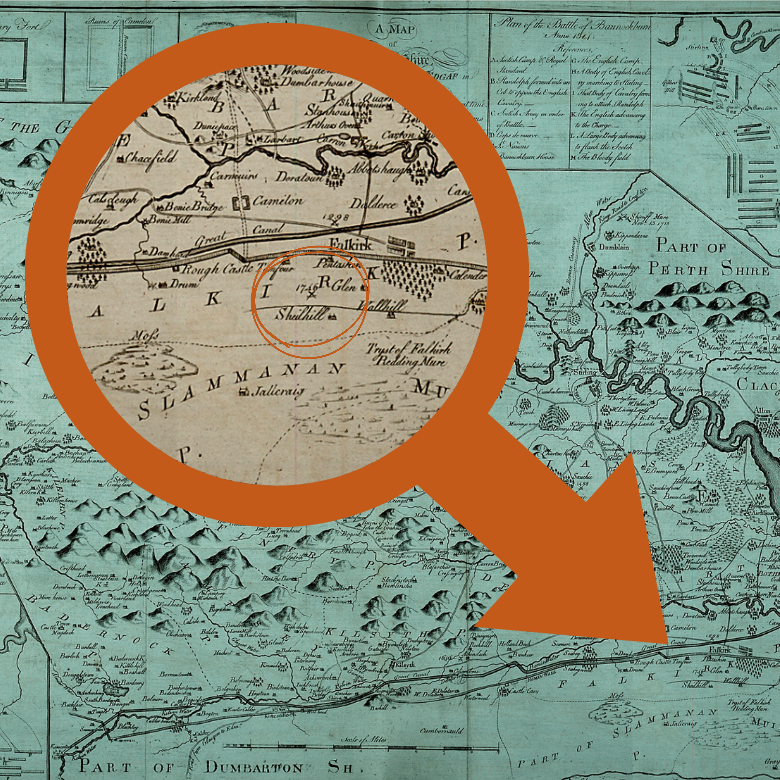
Map of Stirlingshire by William Edgar, dated 1745. It shows the location of the Battle of Falkirk Muir with the date 1746, likely a late edit to the map. © National Museums Scotland. Courtesy of HES.
A plan was hatched whereby the Jacobite Army would advance in two columns. The cavalry and the Irish Pickets (detachments of Irish soldiers from French‑service regiments who fought for the Jacobite cause in Scotland during the 1745–46 risings) were placed under Lord John Drummond. They would move on the left flank, taking the high ground in full view of the enemy. The main body of the army, made up of Highland infantry regiments under Lord George Murray, would advance on lower ground on the right flank. This kept them out of the enemy’s sight.
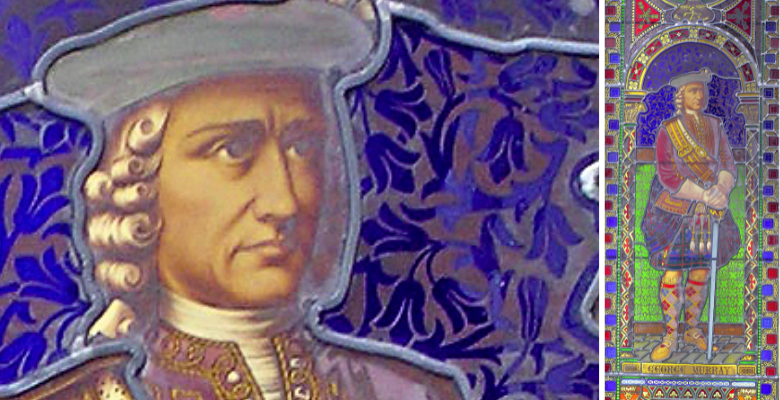
Stained glass window depicting Lord George Murray. Part of a triptych titled “The Soldiers of Fortune”. Now displayed in the Howgate Shopping Centre, Falkirk. Image © Cairns Aitken. Courtesy of HES.
Hawley Hoodwinked
The Jacobite plan worked like a dream. The commander of the government forces, Henry “Hangman” Hawley, concluded that Lord John Drummond’s division comprised the entire Jacobite Army. Furthermore, he guessed (wrongly) that their objective was not Falkirk at all, and they would swing eastwards to advance on Edinburgh. He duly dispatched his crack infantry regiments under Major-General Huske to cut off the Edinburgh Road. It was only after Lord George’s men had crossed the Carron Water that Hawley became aware of their existence. Completely wrong-footed, he had no time to redeploy his infantry, so instead ordered his dragoons under Colonel Ligonier to ride ahead and cut off the Highanders’ advance.
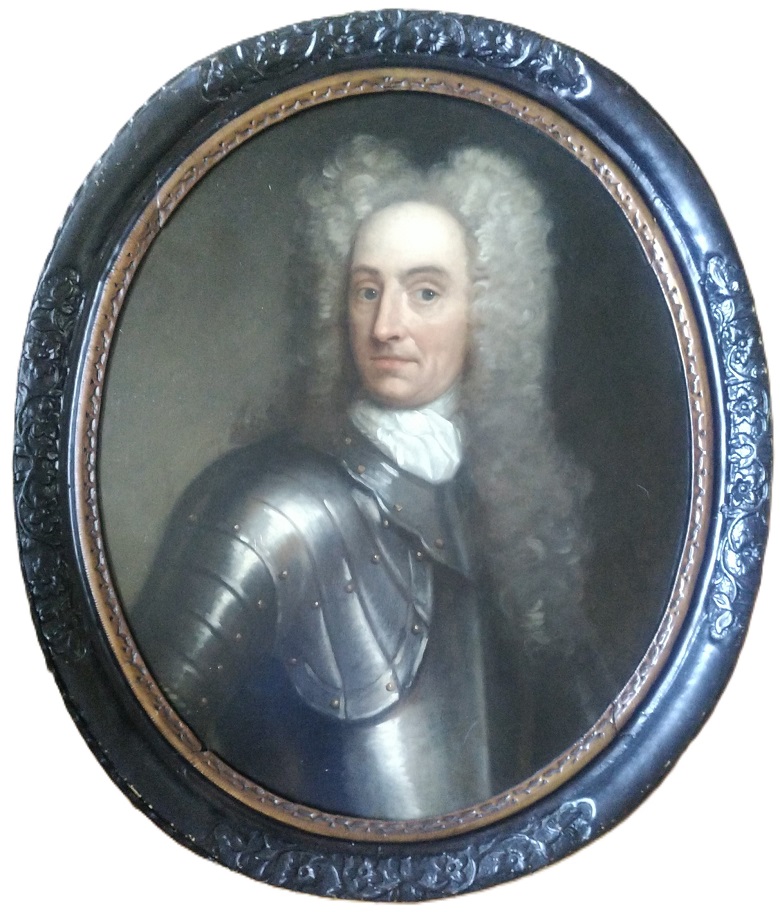
General Henry ‘Hangman’ Hawley – the commander of the government forces at Falkirk Muir. Reproduced by kind permission of the Tulloch Collection.
The Rout of the Government Dragoons
Hawley’s decision to send in the dragoons was a catastrophic mistake. Without covering infantry fire, Ligonier’s horses charged straight into the Highlanders’ musket fire. The dragoons suffered heavy losses in the ensuing melee, and their horses, rearing and galloping away in terror, trampled over the volunteer Government Militia coming up in their rear.
The rout on the right flank was brutal, bloody and confused. The Highlanders pursued their enemy in fury and cut many of them down at the site of the ‘English Graves’ in Dumyat Drive in Falkirk. This became a mass grave where the mortal remains of the Government Dragoons were interred.
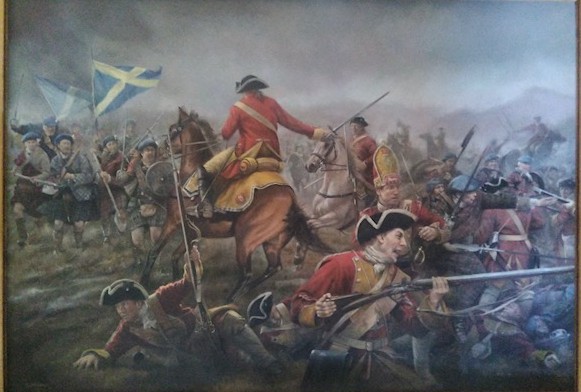
Chris Collingwood, ‘Ligonier’s Dragoons Attack the Jacobite Right Flank at Falkirk Muir’. Reproduced by kind permission of the Tulloch Collection.
The Struggle on the Jacobite Left
Lord George’s Highland regiments routed the government dragoons on the right. Meanwhile, Lochiel’s Camerons, anchoring the Jacobite left flank at the location now marked by the Battlefield Obelisk, came under intense attack from Major‑General Huske’s crack infantry regiments. The attack was so fierce that some Jacobite soldiers on the left fled, believing the day lost.
In fact, at the crucial moment, Prince Charles sent in the Irish Pickets and Ogilvy’s Regiment from the second line to reinforce Lochiel’s position. They succeeded in repelling the government attack. Huske’s regiments retired in good order, but with the failure of their attack the day was won for the Jacobites.
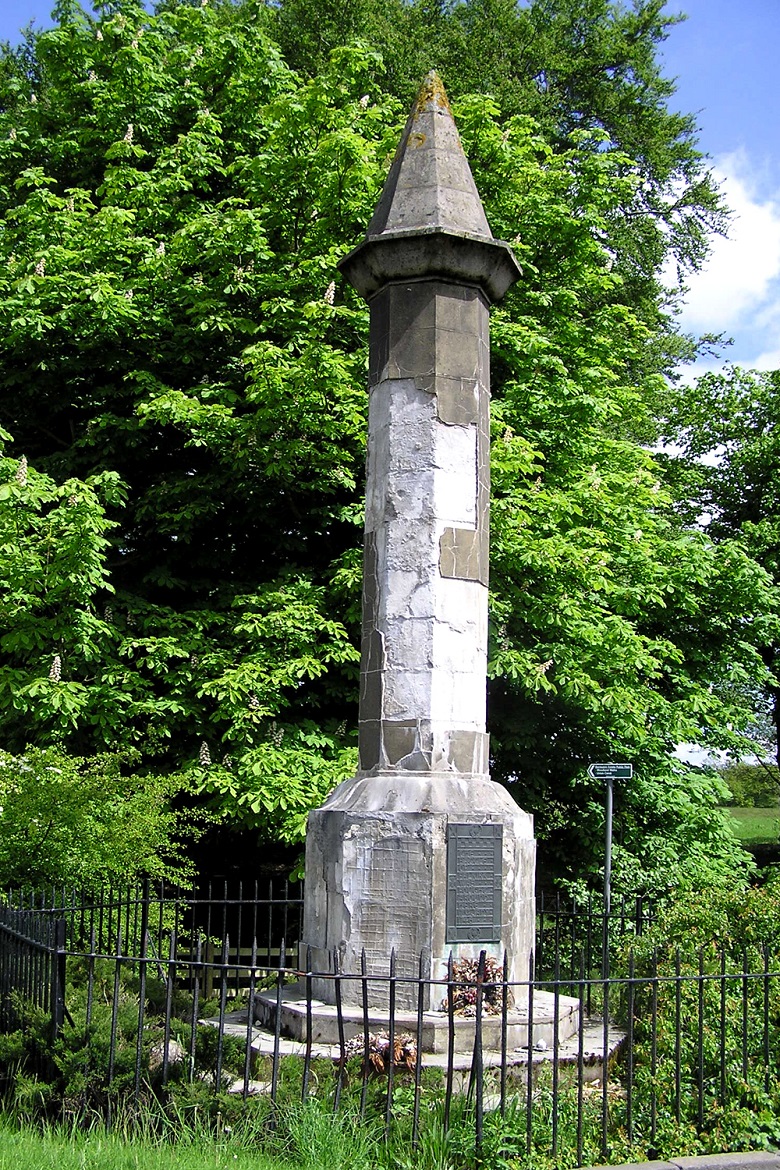
The Falkirk Muir Battlefield Obelisk on Lochgreen Road. This marks the spot where Lochiel’s Camerons anchored the Jacobite Left Flank. © Cairns Aitken. Courtesy of HES.
“Falkirk or Paradise”
“Tonight,” Lord George Murray had told his men, “we shall lie in Falkirk or in Paradise.” He knew that, if his men failed to take the town, many of them risked death from exposure on the bitterly cold moorland above the town. It had been a huge gamble, and it had paid off. That night, Lord George and his men sheltered from the raging storm in the comfort of homes in Falkirk. They were warmed by restorative broth and drams of the whisky that many Highlanders carried with them to bathe wounds and other medicinal purposes, as well as for refreshment.
But the Jacobites failed to follow up their victory. After spending the day of the battle exposed to the elements without food, the Prince succumbed to a severe chest infection. He was laid up in Bannockburn House and unable to lead the army.
It was also during this time, according to the house’s oral traditions, that an assassin fired a shot through the bedroom window. The musket ball narrowly missed Bonnie Prince Charlie as he slept and lodged in the wall at the head of the bed.
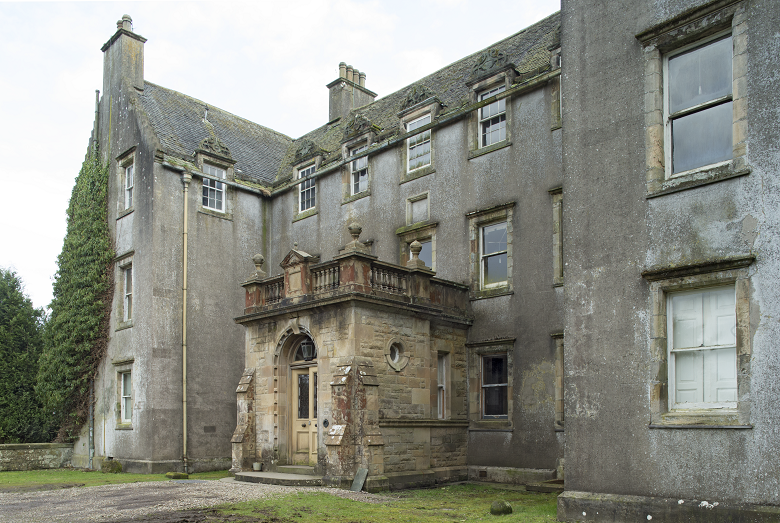
Bannockburn House was purchased through a community buyout in 2017. In 2024, a musket ball hole discovered in a bedroom wall added fascinating evidence to its history. Today, conservation works are underway and further investigations of its history are ongoing.
From his sick bed at Bannockburn House, the Prince gave orders for his army to stand ready until he got better. Critical days were lost, giving time for government reinforcements to arrive in Edinburgh. By the time he had recovered, the Prince had little option but to reluctantly agree to retreat north. There, exhausted and starving, his Jacobite Army was annihilated on Culloden Moor.
Meeting triumph with trepidation
So what moral can be drawn from the story of the Battle of Falkirk Muir? One is that a makeshift organisation can, through discipline, skill and courage, overcome apparently insuperable odds. The Jacobite Army proved that on the day. More profoundly, the memory of the battle may have affected the Scottish psyche in a way that endures to this day. It has perhaps fostered a caution, even a fear, that triumphs may only precede greater disasters like Culloden.
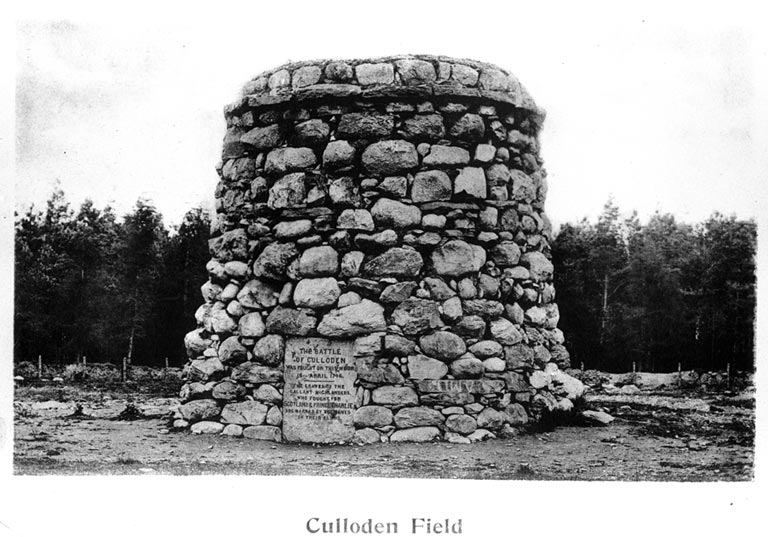
The memorial at Culloden Field. Explore more information about the Culloden Battlefield on trove.scot. Image © St Andrews University Library. Courtesy of HES
About the author

Michael Nevin is the author or ‘Reminiscences of a Jacobite’ (Birlinn, 2020) and ‘The Last Jacobite Victory: The Battle of Falkirk Muir’. He served as Chair of The 1745 Association SCIO between 2016 and 2023.
Banner image credits:
- Prince Charles Edward Stuart © Licensed by National Museums Scotland via SCRAN.
- Map of Stirlingshire © Licensed by National Museums Scotland via SCRAN.
Share
About Author