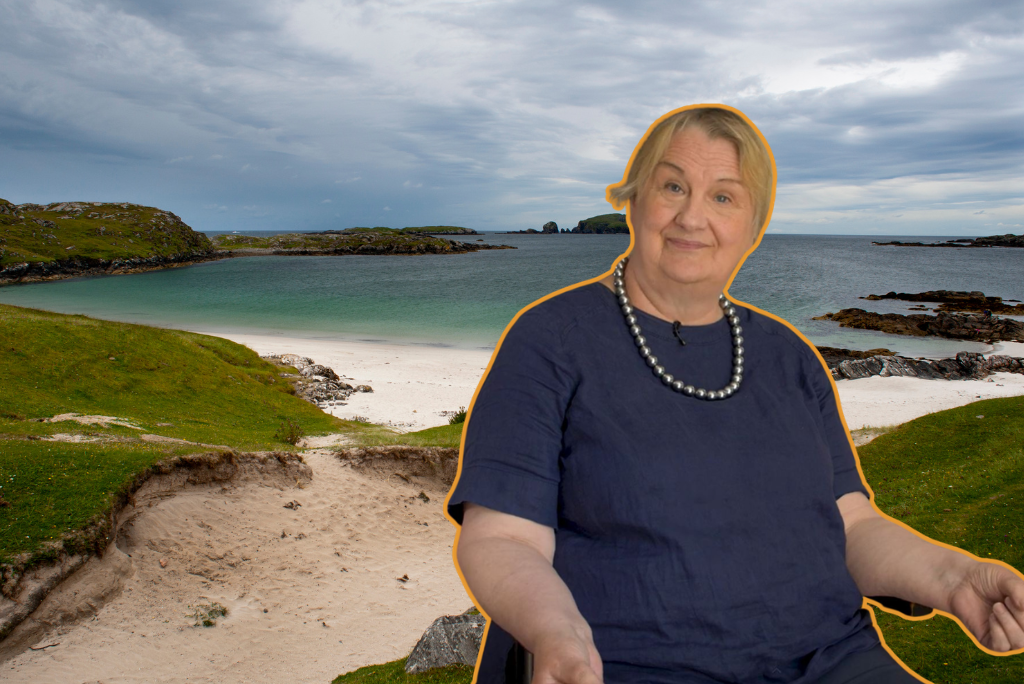
In our latest Gaelic video series ‘Sgeulachdan an Tac an Teine’, storyteller Magaidh Smith invites you to take a seat by the fireside as she tells four traditional tales rooted in the Isle of Lewis. Travel back in time and across the landscape of Lewis meeting members of feuding clans, a fairy cow, a bodach with changing fortunes and a Ciuthach along the way.
Sit back, relax and enjoy the stories on YouTube. Magaidh tells the stories in Gaelic with English subtitles available.
We were interested to hear a little of Magaidh’s own tale and so asked her to write this blog about being a storyteller, how she promotes Gaelic language and culture and her passion for Gaelic stories being passed on for the generations to come.
Stories, language and place
I’m Magaidh Smith a native Gaelic speaker living and working in the Isle of Lewis in the Outer Hebrides of Scotland. I glean stories from oral tradition and share them in my community, in publications in audio files and online. I also facilitate regular live story telling events at An Taigh Ceilidh, Stornoway.
The seanachaidhs of yore memorised large tracts of stories. They were keepers of knowledge and history, able to relay the genealogy of the clan, its moral standards and the punishments should these standards not be adhered to!
That kind of memory training is in the past but constant repetition is still needed to bed in stories and songs. All ages love stories and I enjoy transferring the images in my imagination to others through my storytelling, something which is fairly easy in Gaelic. You need to be immersed in it to tell it.
Before the days of television in my home village of Achmore, my grandfather and other bodachs used to talk about their days shepherding in Patagonia. Through their tales, we imagined Valparaíso was just south of Harris. In my experience, Gaelic culture is very much based on our link to the land, with every story being set in a specific place and the tale unfolding in a landscape with which the storyteller and listener is familiar with.
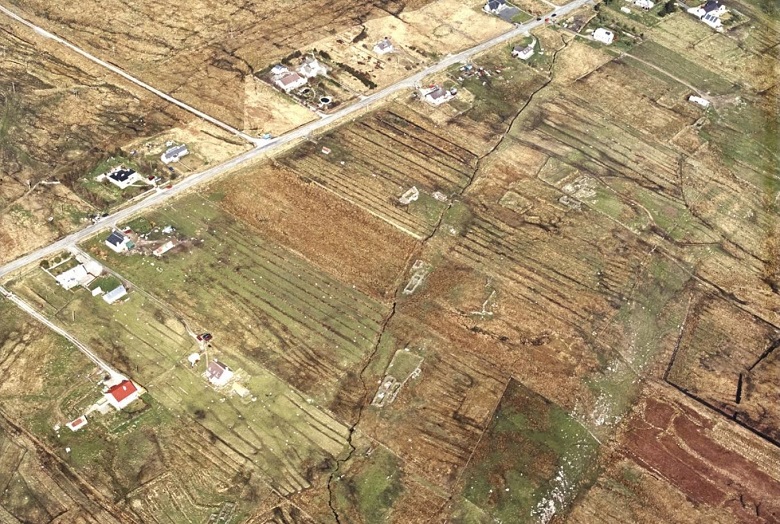
An aerial view of Achmore. Take a closer look on trove.scot.
Crafting a story allows me to share my knowledge of Gaelic and place to those listening. I can bring the story to life with rich Gaelic words absorbed in my youth in a monolingual Gaelic community. What an opportunity to revive those onomatopoeic words! It is imperative to be mindful of setting the cultural and historic contexts and to bridge the gaps in the knowledge of a younger generation. By incorporating local landmarks and place names, I hope the island landscape itself will become a visual reminder of these stories.
A window to the past
Local stories are now being sought by people to help them create a mind map, about the lives of their ancestors and their beliefs. An account of the eviction of Bhuidha Mhòr in Uig in 1851, passed to me through beul-aithris in 2005 was compiled as an article on Hebridean Connections. The tacksman who carried out the evictions got a taste of his own medicine and was in turn evicted, emigrated and fell on hard times in Canada. Earlier this year, a direct relative of the unfortunate tacksman contacted me and is making a pilgrimage to Lewis to find out more about the life of his ancestor. The power of stories can prompt you to visit places but can also leave trauma to be dealt with too.
Stories and links to the past can turn up where you least expect. A rotary quern stone was found recently in Lochs. This has revived the account of a Lochs tacksman from the 1740s, ‘encouraging’ his tenants to use the farm mill, where he could extract a tithe. The tacksman forcibly took the tenants rotary quern stones and threw them into a bay at the mouth of the river estuary at Laxay. The site and landmark Slochd nam Brathan, can still be visited and many Sunday afternoons I lay flat on the ground peering over the bank to try and see the quern stones in the murky waters below. The recent quern stone find, has prompted a suggestion to enlist the help of a diver to count the number of quern stones lying on the seabed. Wouldn’t this be quite something to bring a 300-year-old story alive?
On Tobar an Dualchais (Kist O Riches) you’ll find tales told by Pàdraig Sheonaidh from Barbhas. Pàdraig was a tinsmith who travelled around the Isle of Lewis, memorising the stories he heard. I was particularly interested in one of Pàdraig’s stories with a deliberately vague location due to the story being about a man caught stealing cattle. The story goes that a young man searching for his family’s missing heifer enlisted the help of his father, the blacksmith. Wandering the moorland, nightfall found them on the outskirts of a distant village seeking food and shelter. Various circumstances led them to finding the man who had stolen their heifer. The story is funny and descriptive of the trials of keeping livestock. The upshot was that the blacksmith and son took a heifer from the herd of the cattle rustler. The legacy of dishonour was that the rustler was forever more known island wide as Niall an Aighe, this nickname was the sting in the tale. The name echoed a comment by a cailleach in the village about forty years ago, who told me “I lived on the croft of Niall an Aighe, the cattle rustler”. All she had was the nickname and that he had been rumbled by a cowhide. Imagine my delight at finding a story which related to the ground I am so familiar with. The original account by Pàdraig Sheonaidh has been relayed several times already. What a chance find!
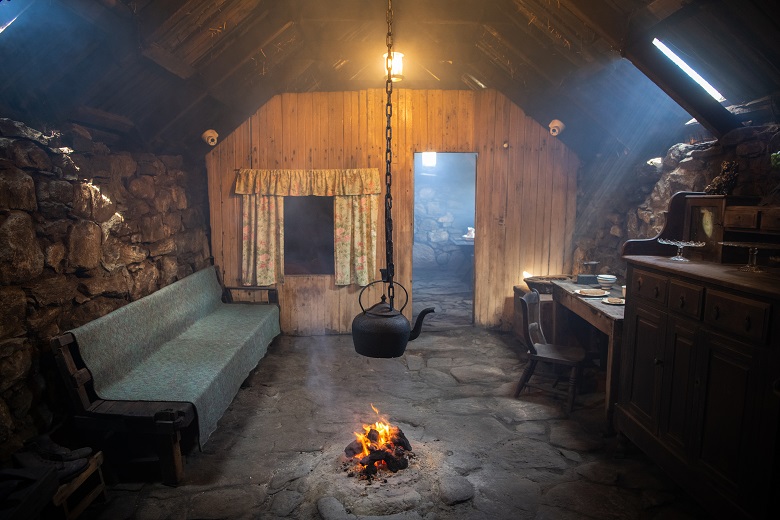
The peat fire at the heart of the Arnol Blackhouse on Lewis would be the perfect spot for a bit of traditional Gaelic storytelling.
Stories for generations to come
Oral traditions and expressions are used to pass on knowledge, cultural and social values and collective memory. They play a crucial part in keeping cultures alive and working to safeguard our Gaelic stories is so important. Here is a flavour of projects and activities I’ve been involved with to ensure our stories are passed onto future generations.
Bloigh Beag le Beannachd is a series of books and CDs of Gaelic stories. They were collected and edited by the late Murdo “HMI” MacLeod (1929-2013) of Gress, Isle of Lewis and Inverness, whilst travelling around the schools in the Highlands & Islands, as Schools’ Inspector in the 1970-90s. This series is a great place for native Gaelic speakers to delve into their own culture and Gaelic learners to help extend vocabulary and grasp a glimpse of the Gael’s relationship with their local landscape.
We are fortunate that there are still vestiges of beul aithris in our community. As part of a current Creative Scotland project, I am recording stories of some of the islands heroic clan leaders from the 1600s, in Gàidhlig, from John Murdo MacDonald, Stornoway. Ducking bow and arrow and swords, marvelling at piracy and buried treasure and plotting sites of clan battles in his tales. Some of those tales will be available in English as well as in a Gàidhlig podcast series. This initiative will also include live events with the storyteller John Murdo MacDonald. These types of events are important as invariable that a yarn about a grave in a moorland location, results in a member of the audience revealing another story the coordinates of another massacre or execution.
I am enthusiastic about songs which originated in Lewis and have gathered local poetry for specific locality publications. One is Amhran Jasper local to my own area of Lochs, recorded as a waulking song by Sgoil Eòlais na h-Alba but still known in this community as a spiritual composition. It tells of a mother’s fervent wish for her soldier son’s safe return from the Napoleonic War and her vision of his army life at the front. It talks of peacocks and wonderous things which puzzled me, until a researcher of the spiritual writing of women, pointed out Jasper’s mother’s vision of the Biblical lands played a part. Amhran Jasper has been given wings as a workshop participant has taken a copy for an Edinburgh waulking group to learn the words as part of their cultural performance.
Humorous songs are a way of sharing fast-disappearing our Intangible Cultural Heritage (or living heritage) and a method for connection. Setting the scene and the observations of the composer in rhyme, they are a great tool for participation during care home activities, visits and Dementia support sessions in the community. The regional variations engage people from across the room and I can tell what part of the island they are from, by their psychical response. The contributions of verses which are new to me, I gleefully take with me to share with the next gathering of islanders.
Thoughts on the future of storytelling
There is not a lot of opportunity to tell stories here in the islands, we have to create more online spaces for those interested and share in other ways to keep them in currency.
There is a big gap to fill and it’s important to celebrate, that buzz word again, our Intangible Cultural Heritage. We need to work with schools and young people to develop an understanding of their local place and environment, and of the history and beliefs of those who lived there in the past. Perhaps the future of Gaelic storytelling could be animation or short clips which are more palatable for some.
There is also a thirst from Gaelic Learners to have access to stories in Gàidhlig for depth of vocabulary and glimpses of the culture and belief of the Gaels, and their respect of the land which sustained them.
Stories turn up in the most unexpected places, never stop looking and listening. ’S e obair latha tòiseachaidh (Beginning is a day’s work).
About the author
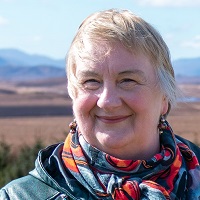
Magaidh is a native Gaelic speaker from Achmore in the Isle of Lewis, where folklore has passed down through generations and continues to shape cultural identity, connecting people to their heritage. She has a passion for preserving and sharing the rich Gaelic heritage of her community. Traditions and island social history are at the heart of everything she does including storytelling research, writing, performance and tour guiding.
Share
About Author