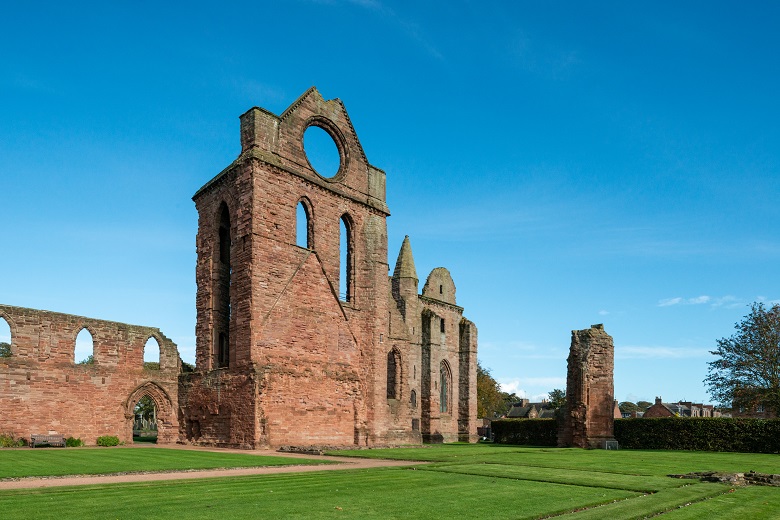
Arbroath Abbey sits proudly on the East Coast of Scotland, the ruins providing a grand reminder of times long past. The Abbey was founded by the ancient King of Scots, William the Lion, and is well known for being his final resting place.
Who was William the Lion?

An 18th century depiction of William the Lion. Likely by Richard Cooper the Elder. View on trove.scot. © Licensed by Hulton Getty (Records of the Scottish Cultural Resources Access Network (SCRAN), Edinburgh, Scotland)
William the Lion (also known as King William I), was King of Scots for 49 years, from 1165 to 1214. After the premature death of his older brother Malcolm, William inherited a Scotland that had been weakened by territorial losses…
William’s older brother, Malcolm IV, had inherited the position of King of Scots at the ripe old age of 12. He was a child thrust into the highest seat of power. His challenges weren’t playground squabbles, they were political crises. Within a few years, he was persuaded by Henry II of England to surrender Cumbria and Northumberland, vast territories that had been hard-won by his grandfather, David I. For a boy barely in his teens, that’s a heavy burden: negotiating with one of the most powerful monarchs in Europe while trying to hold a fragile kingdom together.
When William became king, he wasted no time pressing Henry II to restore Cumbria and Northumberland. By Easter 1166, William was at Windsor Castle, likely using the occasion to renew his claim to the lands his brother had been forced to surrender.
Henry resisted William’s early efforts to regain the lost lands but everything changed in 1173. Henry II’s family turned on him and The Great Revolt began.
The Great Revolt: Invading England

King William I King of Scots depicted by George Henry Hutton, copy made by R. Munro
The Great Revolt was a massive rebellion against Henry. It was a family affair, led by his sons Henry the Young King, Richard (later the Lionheart), and Geoffrey. The revolt was supported by their mother, Eleanor of Aquitaine, and a coalition of nobles and foreign allies.
Eleanor had promised William that Scotland could have Northumberland back. And so, William joined the Great Revolt.
The King of Scots was promptly captured in Alnwick, Northumberland, in 1174. He was handed over to Henry II, with ‘his feet shackled beneath the belly of his horse.’
He saw the inside of prisons all over Henry’s kingdom: first in Yorkshire, later at Northampton, and finally in France. High status prisoners were usually treated quite well. Records show that William was allowed to attend tournaments and other events.
Whilst William endured his imprisonment, Henry II was busy cooking up a cold dish of revenge.
Power to the English: The Treaty of Falaise
The Treaty of Falaise was agreed by William the Lion on 8 December 1174.
The Treaty handed the key powers of Scotland over to England, and gave Henry II control over William the Lion. There would be no more invading England – William had learnt his lesson. In exchange for his freedom, he would have no choice but to surrender Edinburgh and Stirling Castles to to the English. It was a humiliating arrangement.
After joining the failed revolt, William was in a worse position than when he started. William’s ambitions were crushed, and his reign became defined by efforts to restore independence and rebuild authority at home.
The Cost of an Independent Scotland
It took until 1189 for Henry II to die, leaving his son Richard to take the throne.
Richard the Lionhart was keen to fund a crusade. So keen, that when William offered 10,000 marks to dissolve the Treaty of Falaise, Richard agreed. On 5 December 1189, the Quitclaim of Canterbury was signed and Scotland regained full sovereignty and independence.
The Founding of Arbroath Abby
William the Lion founded Arbroath Abbey, Angus, around 1178, and dedicated the building to his childhood friend Thomas Becket, the murdered Archibishop of Canterbury.
The Abbey was also intended to demonstrate the king’s power, and remains a vital landmark of Scotland’s history to this day.
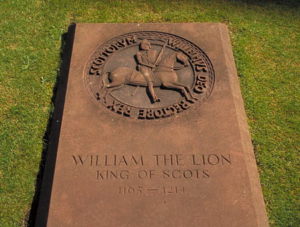
William the Lion’s final resting place, Arbroath Abbey.
William the Lion passed away in his sleep at the palace in Stirling Castle on 4 December 1214 aged 71. He is Scotland’s longest reigning Monarch before the Union of Crowns in 1603.
William was buried at his beautiful legacy of Arbroath Abbey in front of the high altar. His burial marked a break in a century long tradition. All Scottish monarchs had been laid to rest at Dunfermline Abbey since Queen Margaret was buried in the royal mausoleum in Dunfermline in 1093.
William the Lion’s legacy lives on in the ruins of Arbroath Abbey, as well as in the Royal Banner of Scotland. The king’s nickname is thought to be derived from his adoption of the Lion Rampant as his personal emblem. It would later become the Royal Banner of Scotland.

The Royal Banner of Scotland
If you wish to pay the late King of Scots a visit, plan a trip to Arbroath Abbey.
Enjoyed this blog? You can read more about Scotland’s ancient history on our blog.
Share
About Author