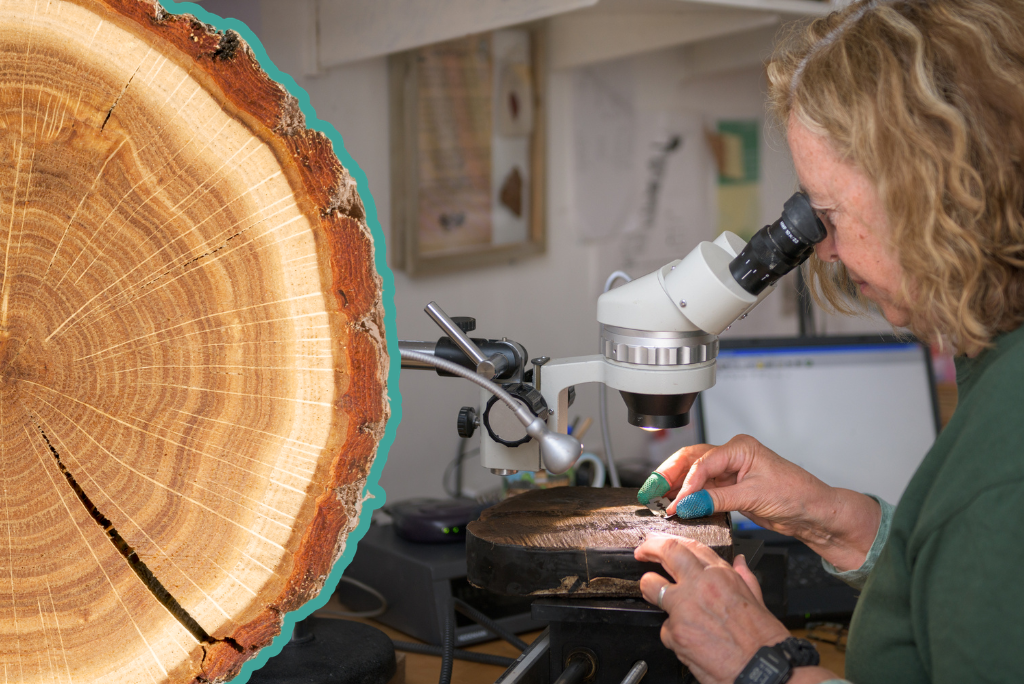
In my life as a dendrochronologist there is never a dull moment. Every timber or tree has a story to tell.
Tree‑ring analysis, also known as dendrochronology, lets us date when a tree was felled and often identify the region where it grew, revealing hidden histories of buildings, landscapes and ships.
In this blog, I share six of my most intriguing recent discoveries from across Scotland. All were carried out with the support of Historic Environment Scotland, either through research grants or at their Properties in Care.
Taken together, these discoveries reveal Scotland’s remarkable timber heritage and the power of dendrochronology to unlock it.
Identifying the Sanday shipwreck, Orkney

Senior Marine Archaeologist Ben Saunders of Wessex Archaeology records the Sanday wreck. Photo credit: Hamish Darrah.
In February 2024, a winter storm revealed a large section of wooden hull on a beach in Sanday, Orkney Islands. At risk of being washed out to sea, Historic Environment Scotland funded an emergency mission to record the wreck and to sample it for dendrochronology.
This mission was undertaken by Wessex Archaeology’s Ben Saunders and Dendrochronicle’s Hamish Darrah, I was on hand to guide the sampling remotely.
A great set of samples were obtained. Thanks to the enormous efforts of the Sanday community, most of the wreck was also recovered from the storm‑battered shore. This allowed more detailed study and onward conservation on Sanday.
What the trees told us
The oak tree-ring samples were analysed, which revealed their mid-18th century date. From the samples we could tell the trees used in the ship’s construction had been cut down between spring 1748 and spring 1762. We were also able to tell that the timbers originated from woodlands in south and south-west England.
The dates and provenance allowed Wessex Archaeology and the Sanday community to focus their documentary research. By knowing when the timber was felled and where it originated, they could narrow their search in shipping and maritime archives.
The strongest candidate by far was the naval frigate HMS Hind which was built in Chichester, and which was later sold off by the navy and converted into a whaling ship, The Earl of Chatham. A whaling mission to Greenland explains how it came to be wrecked on Sanday.
All 56 crew members survived. Sanday was known as the locus of many shipwrecks and had the reputation of being a hospitable place to be wrecked. Hear more about the project from Wessex Archaeology’s Ben Saunders here.
There are thousands of historic wrecks in Scottish waters. Yet before this project, only one other wreck had ever been dated using dendrochronology. The Sanday results reveal the remarkable life story of this vessel and how it came to be on Sanday. They also highlight the largely untapped potential for dendrochronology to be applied to many other wrecks in Scottish waters.
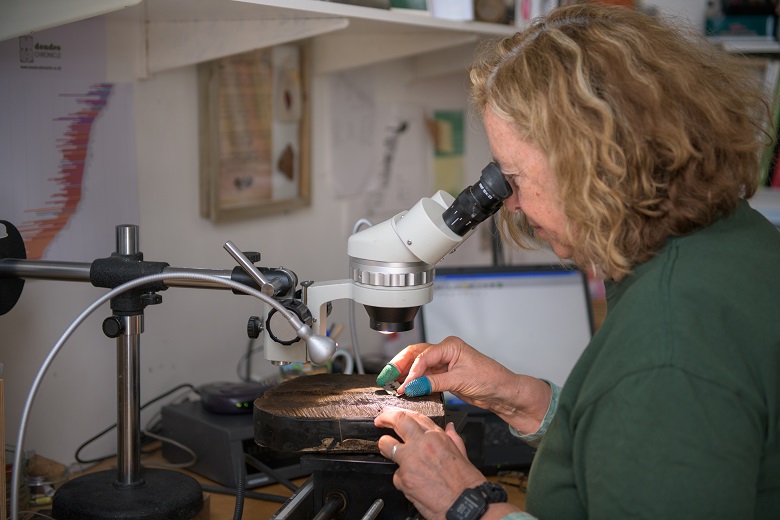
Coralie at the microscope undertaking analysis of a Sanday Wreck timber.
Medieval timbers hidden in St Mary’s Parish Church, Haddington
St Mary’s Parish Church in Haddington has a long and complex history. The original Norman church, first recorded in 1139, stood on the site of the present choir until it was destroyed during Edward III’s campaign in 1356. The current building was begun soon afterwards. It grew into one of the largest late‑medieval churches in Scotland, second in size only to St Giles in Edinburgh. Its ambitious scale reflects the “boom-time” building phase of the 14th and 15th centuries.
This made it a very interesting candidate for investigation!
Invisible from ground level, and hidden above a later vaulted ceiling, is a forest of huge timbers supporting the nave roof of St Mary’s. Many of the beams show signs of earlier use. Some carry two sets of Roman‑numeral carpenter marks, while others have redundant mortise slots or nail‑marks on their inner faces.
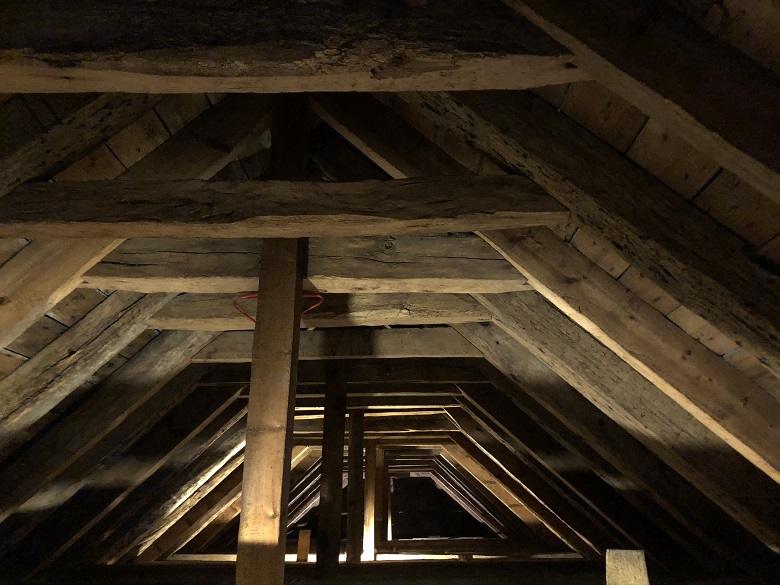
Inside the nave roof of St Mary’s Haddington. Photo credit: Coralie Mills.
What the analysis showed
Tree-ring analysis revealed these oak timbers were felled in the first decade of the 15th century. They must come from the original medieval roofs of St Mary’s. This provides us with the first scientific dating of the church’s construction.
To my great surprise, the dendro-analysis revealed the timbers had been imported from the Gdansk region of what is now Poland. This is one of the earliest examples of timber import yet identified in Scotland. It is very rare to find anything other than boards being brought from this region. The Scots had a trading settlement in what was then Danzig, and there are still parts of Gdansk called Old Scotland and New Scotland reflecting the Scottish presence there in medieval and later times.
The results highlight the dendrochronological potential of pre‑Reformation church buildings in Scotland. Many of these churches still hold medieval timbers that have never been analysed. Investigation could provide valuable insights into construction dates, repair episodes and long‑distance timber trade.
The St Mary’s analysis was undertaken as part of the South East Scotland Oak Dendro project (or SESOD) which was supported by a HES Research Grant. You can read more about SESOD here.
The 15th‑century bell tower at St Giles’ Cathedral, Edinburgh
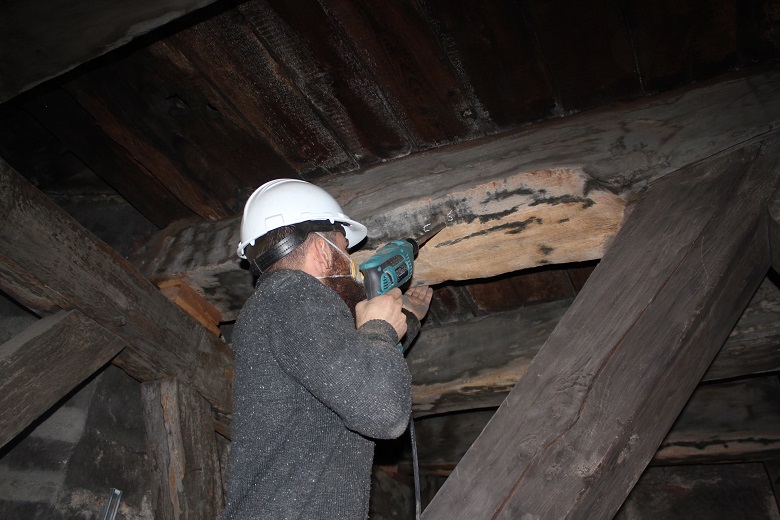
Hamish Darrah coring in the bell tower at St Giles Cathedral. Photo credit: Coralie Mills.
Staying in south‑east Scotland, we were also curious about the great crown of St Giles Cathedral on Edinburgh’s High Street. Before the pandemic hit in 2020, we sampled the gigantic five storey timber frame hidden within the tower as part of the SESOD project.
The results showed that the impressive oak timbers were felled between winter 1453/4 and winter 1459/60. We also discovered that they were native oak but not local oak. They were brought all the way from north-east Scotland, possibly from the medieval Forest of Darnaway in Morayshire.
Of the buildings that have been analysed in Edinburgh’s Old Town, most of them date to the 16th century and contain Norwegian oak. The St Giles bell tower frame represents the earliest timber structure in the area and it’s the only site so far in the old town to have native timber in it.
Again, the results highlight the largely untapped potential of pre-Reformation church timbers in Scotland. Read more about this remarkable discovery at St Giles in a previous blog.
Neidpath Castle: Native oak and Norwegian imports
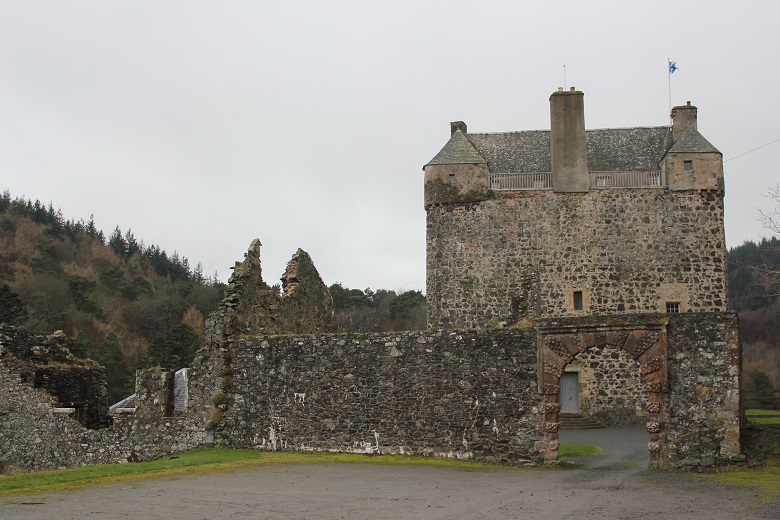
Neidpath Castle near Peebles. Photo credit: Coralie Mills.
Dramatically situated on a rocky outcrop above the River Tweed, Neidpath Castle survives largely intact and has many historic timbers still in situ. These were sampled for the SESOD project and produced some spectacular results.
The basement ceiling has a set of massive oak joists which supports the Laigh Hall floor above. Dendrochronology revealed felling dates in the winters of 1412/13 and 1414/15. It also showed these are native oak timbers probably from the now lost Ettrick Forest in which Neidpath was situated. This is the earliest in situ native oak structure known in southern Scotland.
The roof timbers of Neidpath Castle have a different story to tell. They proved to be mid-16th century with a felling date of winter 1551/52 and to have been imported from Norway. This was a surprise given Neidpath is some 100 km inland along the River Tweed. The reliance on imported timber suggests that suitable native oak was no longer available. This points to major woodland loss in the late medieval Scottish Borders. The depletion may relate to the region’s repeated role as a battlefield with England. Long‑term grazing pressure may also have contributed to the decline in woodland cover.
Neidpath Castle has special meaning for me as I was married there in 2003. We were the first couple ever to be married there. It was while scouting wedding venues that I first saw the historic timbers in the castle and made a mental note of them for future reference.
The Guardhouse and Fort Major’s House, Stirling Castle
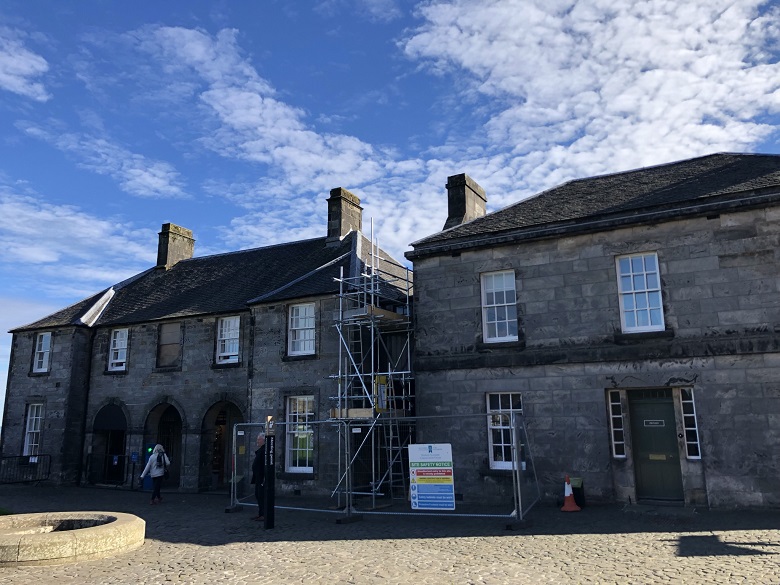
Stirling Castle has benefitted from the highest number of dendrochronological studies of any site in Scotland. Until recently such work was concentrated on the earlier buildings like the 16th century Renaissance Palace and the Great Hall. More recently Dendrochronicle was commissioned by HES to study two later buildings from the period when the castle served as a British army garrison, the Main Guardhouse and the Fort Major’s House.
The two roofs are structurally very different. The Guardhouse has a typical Scottish common‑rafter roof, where paired rafters lean together to form the roof shape without major internal supports. A sort of simple triangle.
The Fort Major’s House instead uses a trussed roof. This means the principal rafters are supported by further large sections of timber, known as trusses, which add strength and stability.
Both roofs share some key features. Dendrochronology showed that each one was built with pine from southern Norway. A further similarity is the presence of curious marks incised into many timbers. The dendro results allowed us to make the first identification of Norwegian timber “shipping marks” anywhere. Before this project, such marks were thought to occur only on timber from the eastern Baltic.
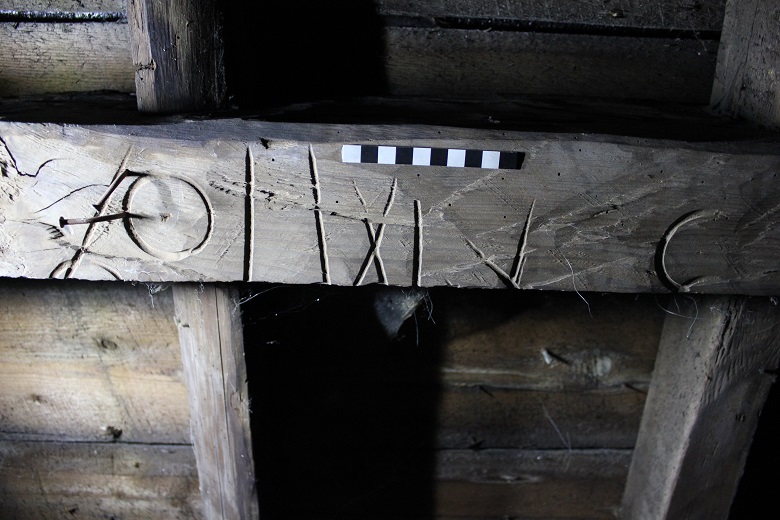
Shipping mark in the Fort Major’s House roof. Scale in cm. Photo credit: Hamish Darrah.
The roofs also differ in their felling dates. The Main Guardhouse timbers were felled in the winter of 1795/6. The Fort Major’s House timbers were felled between 1804/5 and 1809/10. That spread of dates suggests the wrights were working with a stock‑piled store of imported timber.
Read more about this and the other dendro studies at Stirling Castle.
Caerlaverock Castle Wood, Dumfriesshire
With the Dendrochronicle team, I also undertake Historic Woodland Studies, sometimes with dendrochronology, sometimes without.
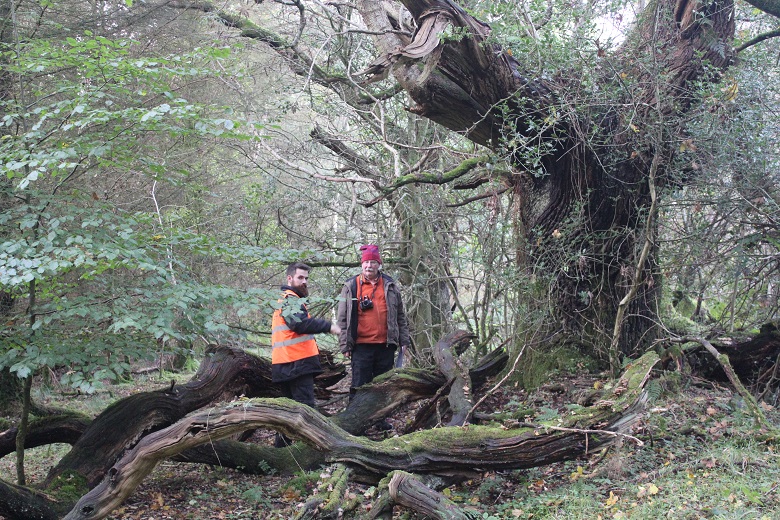
Hamish Darrah and Peter Quelch of Dendrochronicle beside an ancient pollard oak at Caerlaverock. Photo credit: Coralie Mills.
HES commissioned a study of Caerlaverock Castle Wood in Dumfriesshire a handful of years ago. Using a combination of field survey, tree-form studies, historic map work and LIDAR, we were able to work out much of the history of the woodland. No dendrochronology was undertaken in this case.
There are hundreds of old trees in the wood, many of them associated with the rich archaeological remains. Our work showed that the dense tree cover seen today is mostly the result of later plantation. In medieval times, the trees would have been limited to wood banks and the boundaries of the various enclosures around the castle.
The range of tree forms includes maidens (single stemmed trees), pollards and historic coppiced oaks. These are mostly growing from the medieval and later enclosure banks.
There had been previous dendrochronological work by Mike Baillie and Dave Brown of Queens University Belfast on bridge timbers preserved in the moats of the two castles at the site. The timbers at the older of the two castles was shown to be early 13th century, while the upstanding castle with its triangular moat originated in the late 13th century.
The woodland is really worth a visit. There is a good path and an opportunity to spot some of the historic features and characterful old trees as you walk. It can be very wet so bring your wellies. Find out more about Caerlaverock Castle Wood here.
Thank you!
If you’d like to find out more about dendrochronology or the kind of work we do, you can explore the Dendrochronicle website.
And if the themes in this blog have sparked your interest, the Dendrochronology Research Framework for Scotland is well worth a look. I was one of the contributors, and it includes accessible chapters on tree‑ring work in historic buildings, archaeological sites and wooded landscapes, along with lots of case studies.
Finally, a big thank you to HES for supporting these projects and inviting me to write this blog, and to the many owners and custodians who kindly allowed sampling. I’m also grateful to my colleagues at Dendrochronicle — Hamish Darrah, Peter Quelch and Linda Harkness — for all their help, and to fellow dendrochronologists more widely. This is always a collaborative science, and none of this work happens alone.
Share
About Author