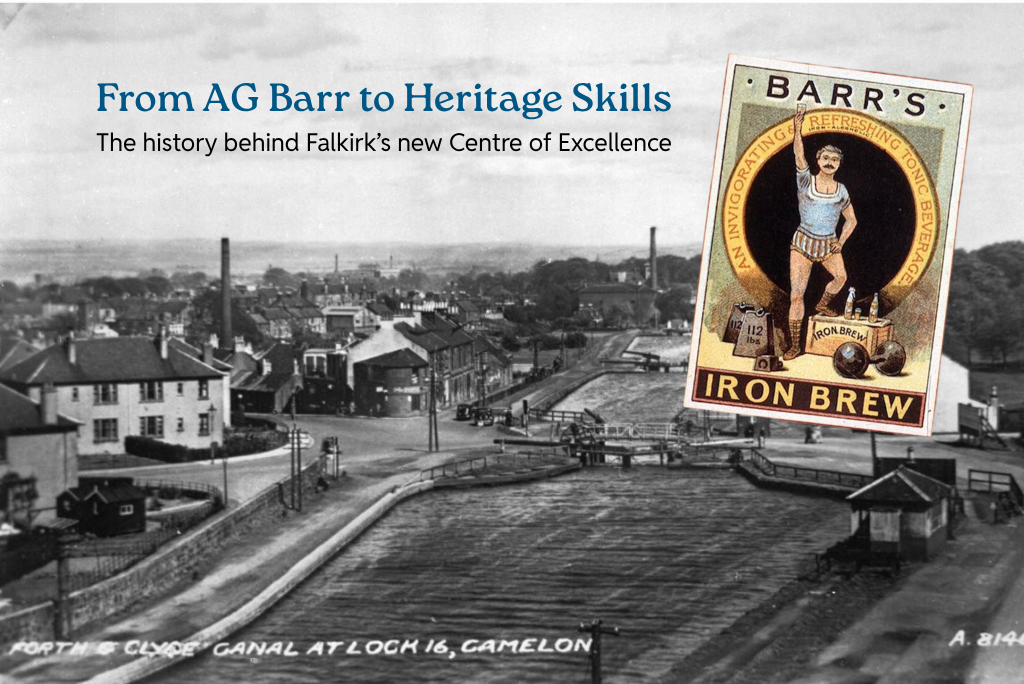
The former AG Barr factory in Camelon, Falkirk is becoming Scotland’s Centre of Excellence for Canals and Traditional Skills. A partnership project between Scottish Canals and Historical Environment Scotland will see the site that distributed the iconic Irn-Bru drink will begin a new life supporting Scotland’s heritage and historic environment. Read on to discover the story of the site: from Irn-Bru to heritage skills.
The origins of AG Barr
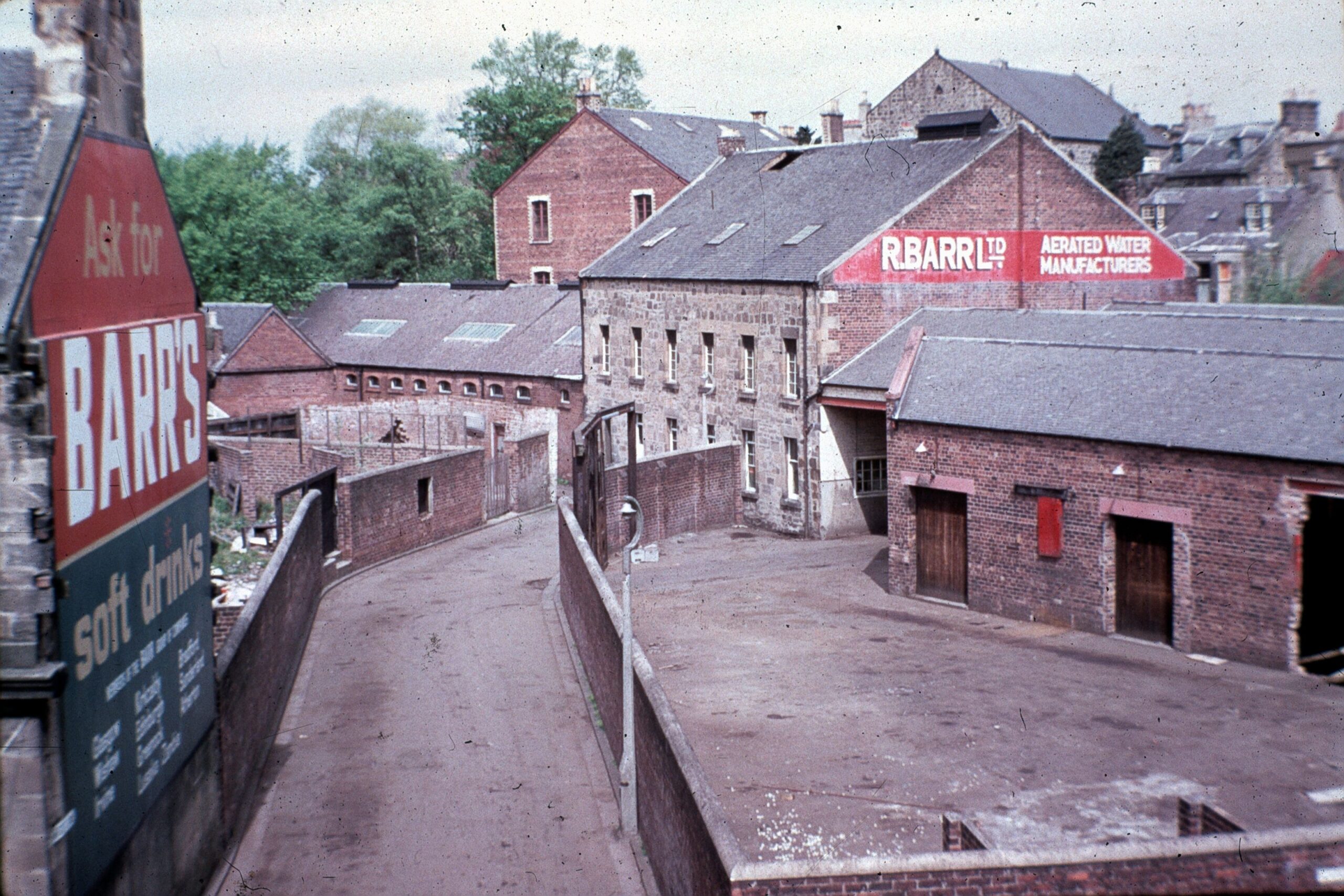
Barr’s works, Burnfoot Lane, Falkirk (22 May 1970). Copyright Falkirk Council, P06131.
The Camelon factory was not the beginning of AG Barr in Falkirk. It all began with Robert Barr’s cork cutting business in 1830. After the cork cutting industry started to decline, Barr’s business eventually developed into aerated waters production. By 1880, they were established as a soft drinks manufacturer in Burnfoot Lane, Falkirk, which became a longstanding factory for the company. This site was one of over 20 factories specialising in aerated waters in Falkirk, and one of many more throughout Scotland. Yet, despite the crowded market at the time, AG Barr has kept above the competition and continues to produce in Scotland today.
Andrew Greig Barr, a grandson of the original cork cutter, started manufacturing aeriated waters with his brother in Glasgow in the late nineteenth century. He was the first person in the West of Scotland to manufacture soft drinks with resealable screw stoppers. His plans to turn his business into a limited company formed AG Barr & Co Ltd in 1904, which gave the company the name still used to this day. This business ran parallel to the original Barr business in Falkirk for several years. Eventually the family enterprises were consolidated in 1959, when AG Barr purchased the original Robert Barr Ltd.
Irn-Bru
The Barr factories were examples of the hundreds of soft drinks businesses that existed in the late nineteenth century. The soft drink expansion reflected the needs of growing industrial towns. They provided guaranteed safe quality drinking water, along with a sugary energy boost. History was made when Barr’s ‘Iron Brew’ was jointly launched by the Falkirk and Glasgow businesses on Monday 15 April 1901. No one could have predicted the popularity and cultural influence of the drink that has continued today.
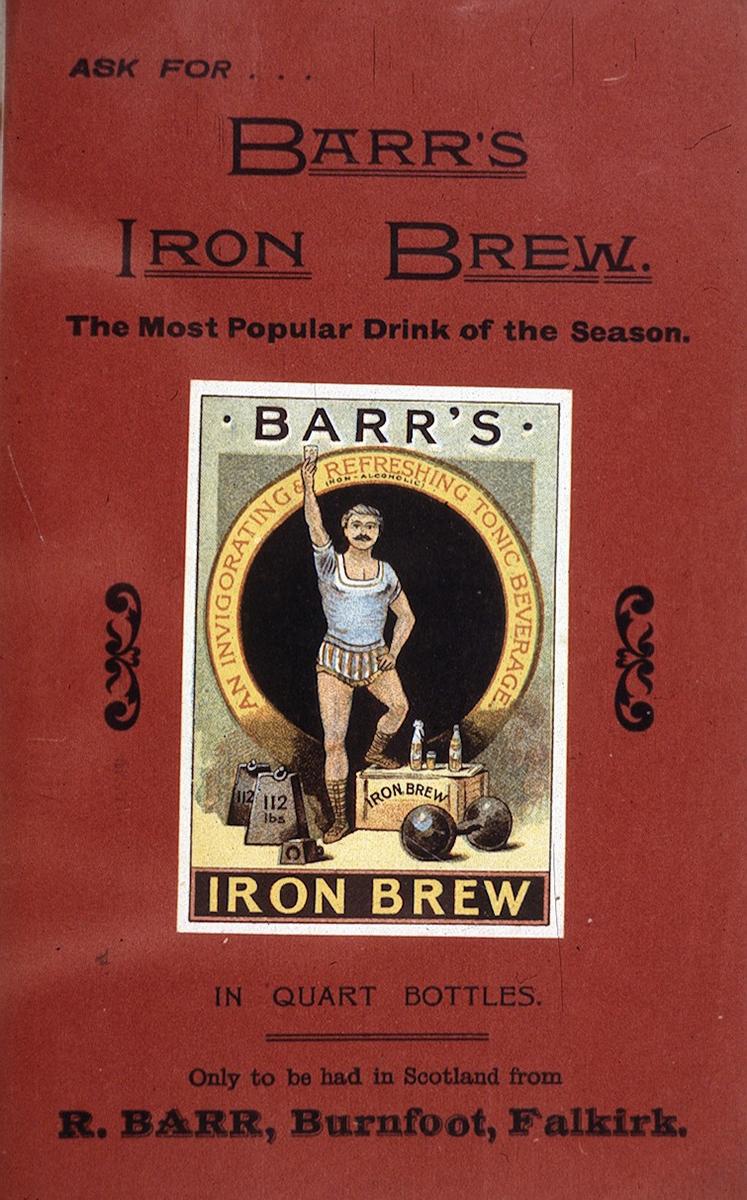
Advertisement for Barr’s Iron Brew from 1900. Published in “The Falkirk Cookery Book” (John Callendar). From Falkirk Council archives, P15256.
The production of Iron Brew stopped in 1942 due to Second World War manufacturing restrictions. Shortages in raw materials forced the Government to limit the soft drinks industry across the UK. New regulations meant only selected companies could produce six ‘standard drinks’. Though AG Barr was able to continue to produce products, Iron Brew was not a standard drink and was therefore not sold again until 1947. Despite the halt in production, Barr continued to produce advertisements in the hope that there would be anticipation for its return.
When the drink was reintroduced, it was reborn as ‘IRN-BRU’. The company modified the name to the one we know it today due to a proposed postwar change in labelling regulations. The name Iron Brew was not ‘literally true’ as the regulations wanted: though it contained iron, it was not brewed. Although this name change proved to be unnecessary as the changes were modified, the phonetically named IRN-BRU is the one we all know and love.
Carnera the horse in Falkirk
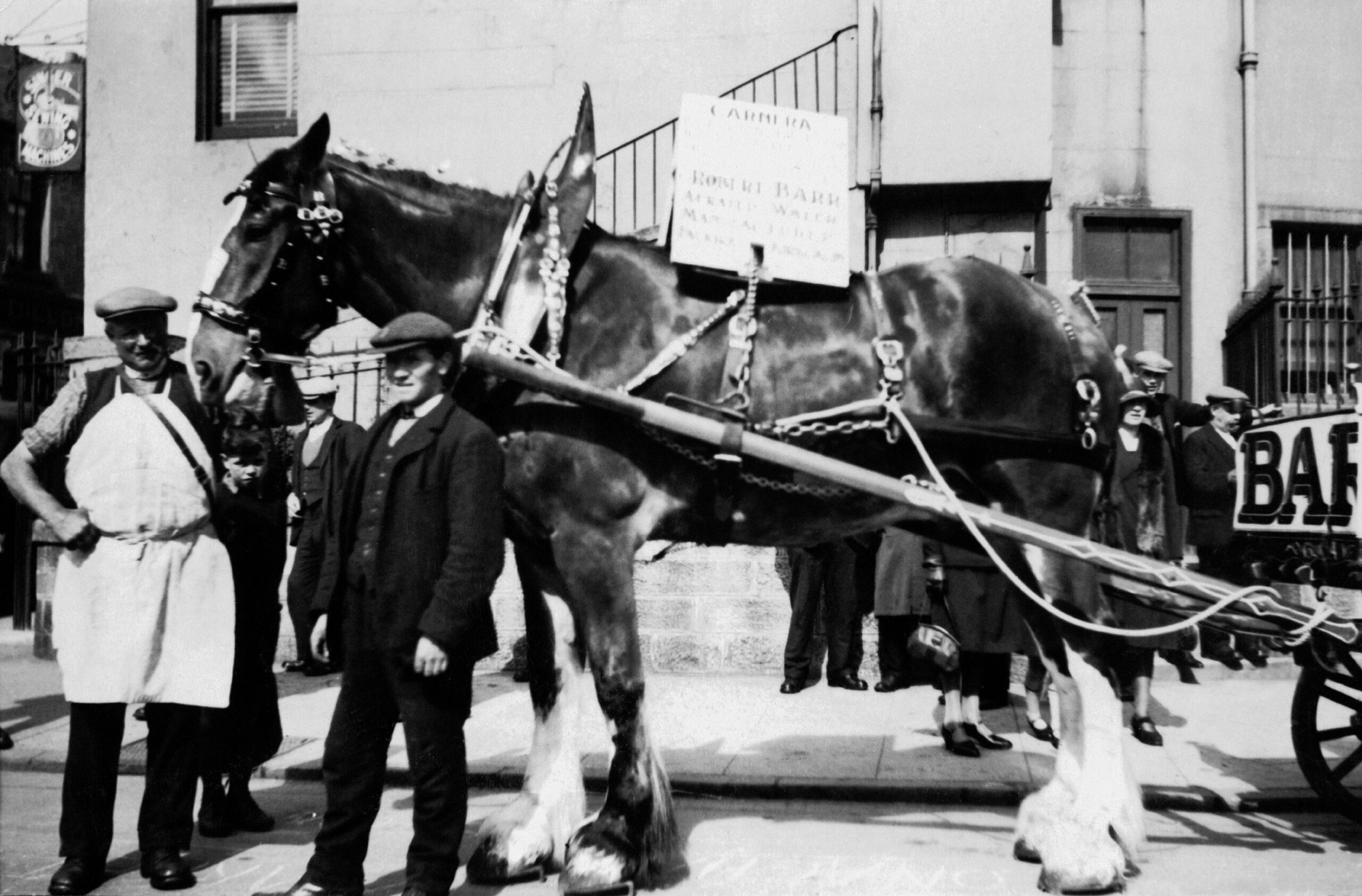
View of Carnera – “Worlds largest horse” – outside Callendar Riggs, High Street, Falkirk. Copyright Falkirk Council, P40976.
Before lorries, the Barr factories delivered their products with horse drawn transport. These horses are synonymous with early photos of the original Falkirk factory. They have been a source of nostalgia when looking back on the ‘early days’ of Barr. At one time, Barr Falkirk was famous for claiming to have the world’s largest working horse.
He was named Carnera, after the Italian ‘Ambling Amp’ of boxing fame and was a staple of the business in the 1930s. He stood at 19 hands 2” tall. Workers claimed and that it took 26” of iron to make him a front shoe. Sadly, Carnera slipped on ice while doing deliveries on Cow Wynd, Falkirk. While initially regaining his feet, he collapsed later in the day around the same spot. Workers brought mattresses from a nearby shop for him to rest. Despite three visits by a veterinary surgeon, he was put to sleep later that day. One article wrote “possibly no greater effort has been made to keep a working horse alive.” Hundreds gathered to see him in his final hours.
Hopedale, Camelon
The Burnfoot site remained as the pillar of the Barr’s brand in Falkirk until it moved to its new location at Hopedale, Camelon in 1971. The new factory was constructed on the lowest basin of the lock system which linked the Union Canal and the Forth and Clyde Canal, known historically as ‘Lock Sixteen’.
Lock Sixteen
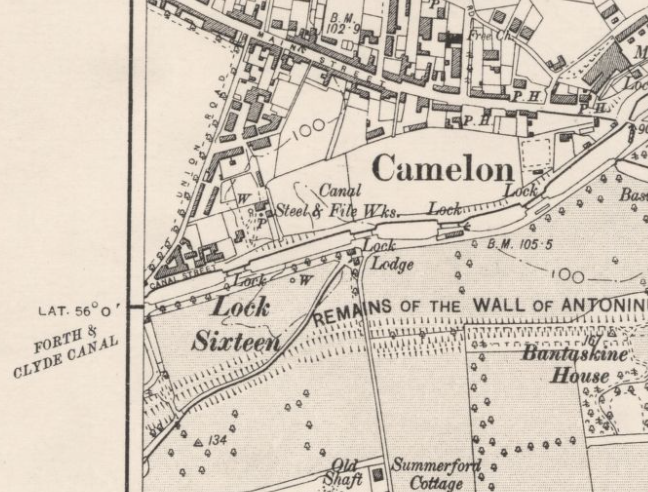
Lock Sixteen (Ordnance Survey, 1899). Reproduced with the permission of the National Library of Scotland (Attribution 4.0 International (CC BY 4.0)
The Camelon factory signified conscious improvement in the immediate area surrounding Lock Sixteen. The area was neglected after the lock was filled in years prior. As part of the wider improvements, the formation of the site complimented a new road complex and the creation of two new blocks of flats built for Falkirk Town Council.
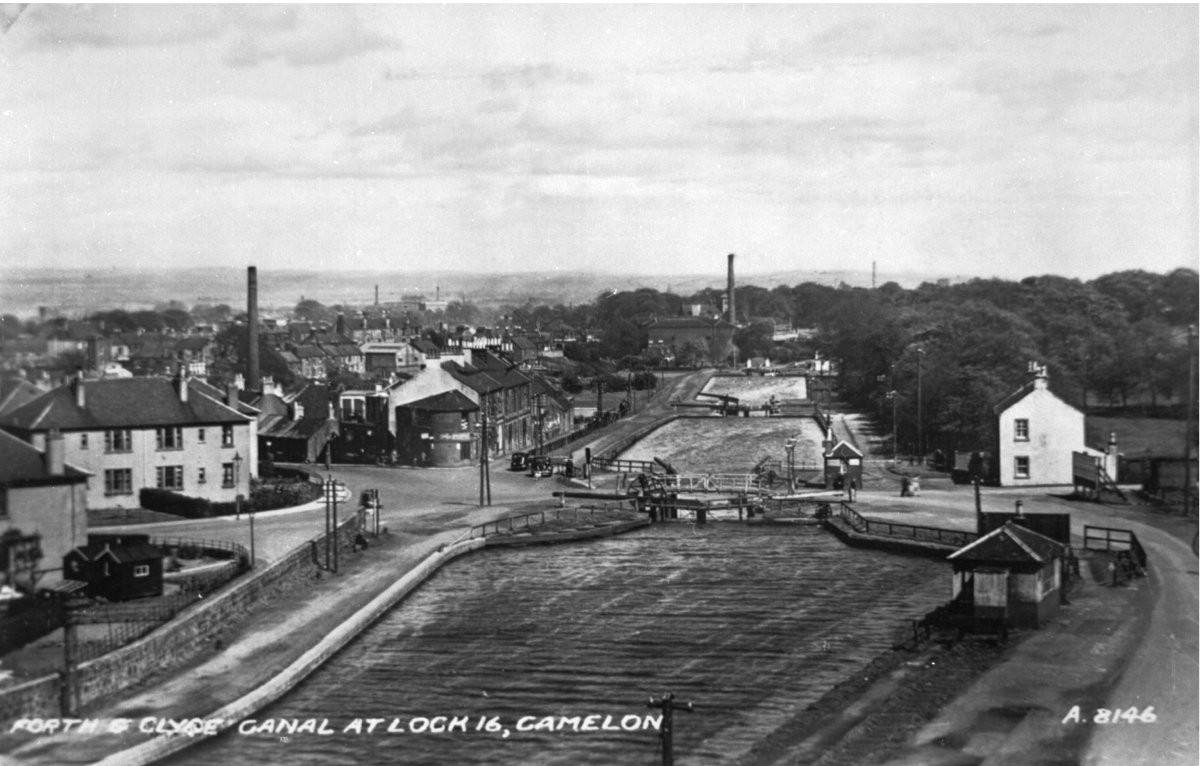
View looking down the Forth and Clyde Canal over Lock Sixteen, circa 1935. Licensed by Falkirk Museums. View on trove.scot.
The new factory itself was truly innovative. Its design to allow for future expansion and aimed to create an easy flow of production and delivery vehicle use. It included a ‘pump island’ in the forecourt to maintain the lorries, a high-pressure vehicle wash bay, and a projected ‘cat walk’ as an extension to the syrup room, with a roof designed to accommodate this. The building was made of “quality facing brick and enamelled steel wall cladding.” It became a key part of Barr’s production, employing 75 people at its peak. Despite this, the last bottle of Irn-Bru produced in this factory was only in August 1996. The company deemed the site too small, and moved production to its current location in Cumbernauld. The Camelon site remained as a small distribution depot until 2006. That year, AG Barr officially took the ‘fizz out of Falkirk’ as one newspaper reported.
Irn-Bru: ‘Made in Scotland from Girders’
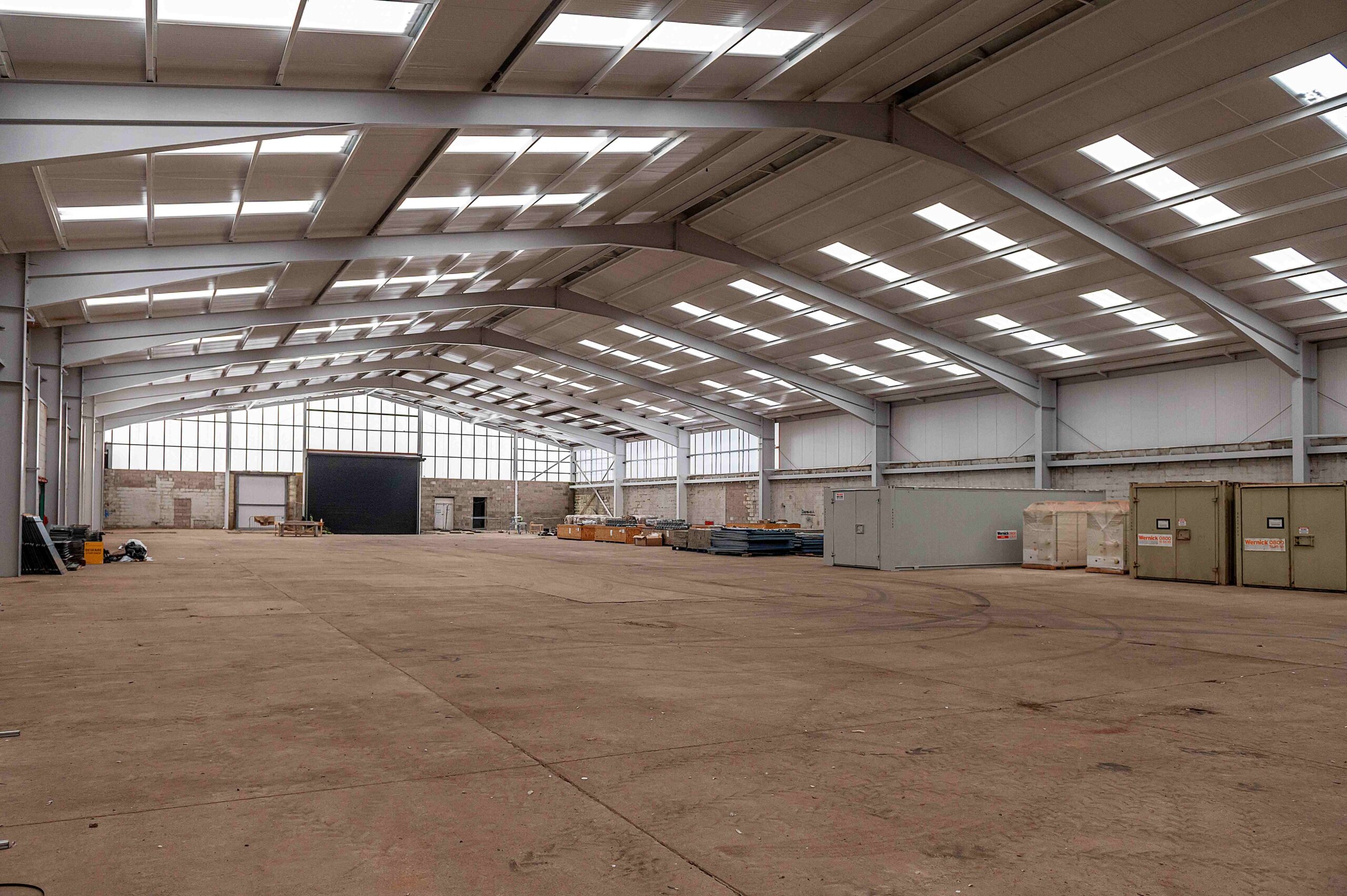
Hopedale, Camelon Factory. Image: Scottish Canals
Just as Irn-Bru’s girders have kept us strong throughout the years, the girders that held up their Camelon site are being repurposed to keep Scotland’s heritage strong for the future.
The building is starting a new chapter at the heart of an ambitious national project. It will be a Centre of Excellence for traditional and heritage skills, Scotland’s largest dedicated training facility of its kind. The centre will combine practical, hands-on learning, with eLearning, making specialist skills more accessible to learners across the country.
The site is rooted in the history of the Forth & Clyde Canal and the local community. As it enters a new phase of renewal, it’s great to reflect on the long history of AG Barr in Falkirk.
Find out more
Interested in Scotland’s industrial heritage? Discover more stories on our blog.
The site is entering a new phase, with a new Retrofit Centre for Traditional Buildings helping to grow training opportunities, enable testing of retrofit measures and strengthen the skills needed to care for Scotland’s historic environment. Find out more here.
If you want to see some of the cutting-edge heritage science equipment that will be used in the Retrofit Centre, join us at the Engine Shed in Stirling for Doors Open Days on Saturday 26 and Sunday 27 September.
Learn how we’re doing our bit to keep traditional building skills alive and accessible on our website.
Share
About Author