
The 1600s were a turbulent time for Scotland. The growth of global trade and colonial exploits via sea had seen many European countries gain in wealth, but Scotland remained a poor country in comparison. Many areas were still very much a rural society and there were few goods to trade abroad. Disruption to shipping in the North Sea caused by England’s wars with the Dutch and French made it difficult to export the products that were available. The century also saw additional taxation, poor harvests and famine.
Scotland and England shared the same monarch, but they were still separate countries with their own parliaments. English law excluded Scottish ships and merchants from accessing their colonial markets as Scotland was considered a foreign nation. At least 75% of the crew on board an English ship had to be from England or the colonies, limiting opportunities for Scottish individuals. If the Scots wanted to share in the same successes and profits of empire as their neighbours, they would need to take matters into their own hands.
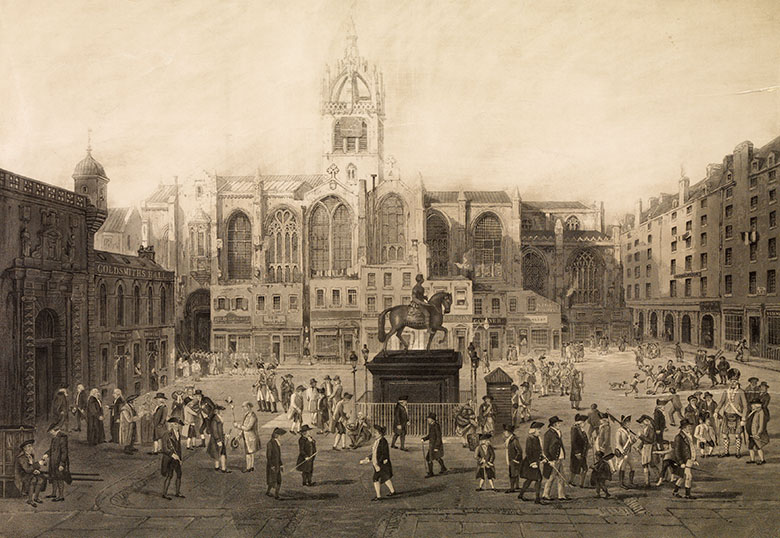
The Scottish Parliament in Parliament Square on the High Street in Edinburgh, pictured in 1844. The Scottish Parliament met here from 1632 until its dissolution with the Act of Union in 1707. Image © Courtesy of HES
The Company of Scotland Trading to Africa and the Indies
The Company of Scotland trading to Africa and the Indies (now often referred to as the Darien Company) was founded in 1695. It would operate as a joint stock company, meaning multiple investors pooled their resources to fund its activities, and would share in any profits made. Many companies like this were founded during this period. The East India Company, founded in London in 1600, is one of the most famous and successful examples.
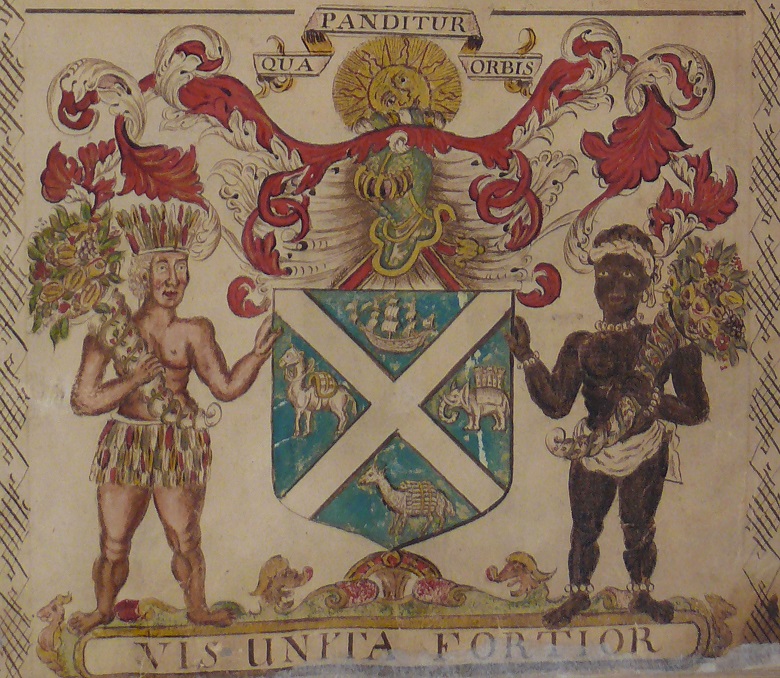
The Company of Scotland Coat of Arms. The two supporters represent stereotype of an indigenous American and an African carrying horns of plenty to represent abundance. Reproduced by kind permission of NatWest Group © 2026
The money behind the mission
Originally the plan was for the company be a joint Anglo-Scottish venture, with expertise and investment from the English and company directors on both sides of the border. A subscription book was opened in London in 1695 to raise £300,000 – half the capital needed for the scheme and roughly £56 million in today’s terms. The required amount was reached but not everyone was happy. This new company would be a serious rival to the powerful East India Company. They lobbied King William III and the English Parliament to intervene. The House of Commons decreed that anyone who had signed the subscription book should be impeached on grounds of high treason, and the English element of the scheme was quickly abandoned.
This setback didn’t deter the company directors. In February 1696, a subscription book was opened in Edinburgh with the aim of raising the sum of £400,000 – an enormous sum for a small country. Over 1300 shareholders were drawn into the scheme from all walks of life, including members of the nobility and gentry, institutions, doctors and church ministers, merchants and tradespeople. Trinity House of Leith, now cared for by Historic Environment Scotland, invested £200 in the scheme.
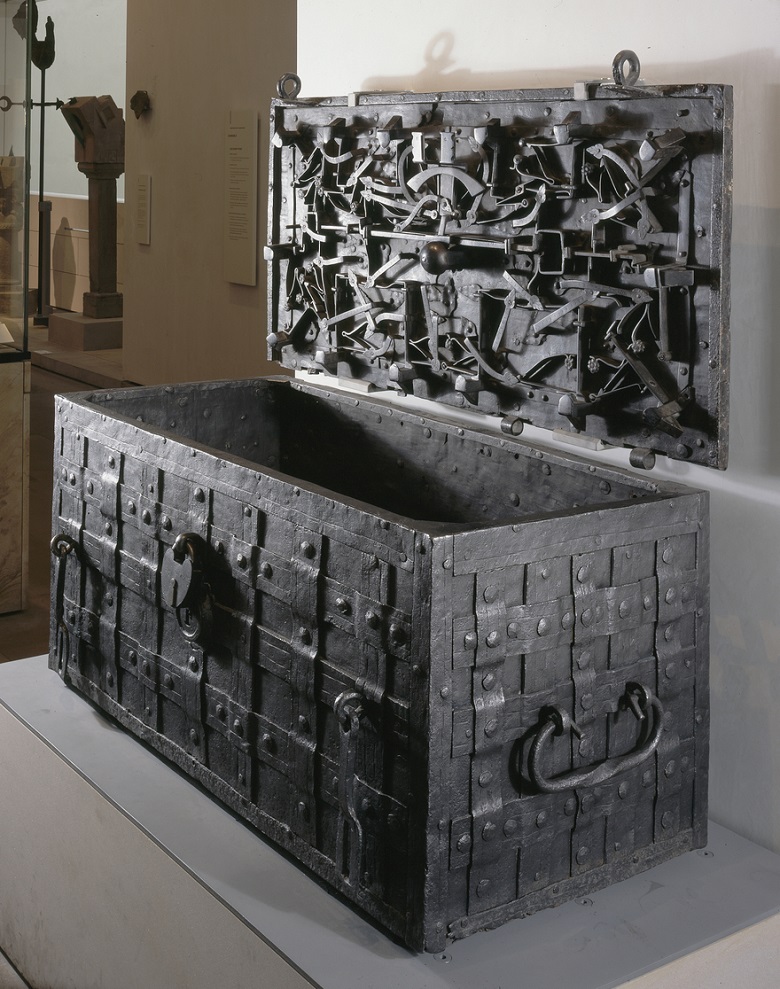
Iron lid of a safe or treasure chest of the Darien Company, with a complicated lock of fifteen spring bolts, 1695. Image © National Museums Scotland
William Paterson and the Darien Scheme
Although huge numbers of Scots flocked to sign up to the subscription book, the detail of exactly what and where the company would be trading were still to be agreed. Numerous options were discussed, and during the company’s short history it was involved in several ventures. However, it is the Darien Scheme that has gone down in history as the most infamous.
The proposal for establish a settlement at Darien (modern-day Panama in Central America) came from a man called William Paterson. Paterson was born in Dumfriesshire and had an interest in economics and trade. He helped establish both the Bank of England and Bank of Scotland, as well as the Darien Company where he also became a director.

A portrait of William Paterson. © The Trustees of the British Museum. Shared under a Creative Commons Attribution-NonCommercial-ShareAlike 4.0 International (CC BY-NC-SA 4.0) licence.
Paterson argued that Darien’s shape and position – a thin stretch of land known as an ‘isthmus’ which separated the Atlantic and Pacific Ocean’s – was the perfect location for establishing a land route between east and west. This would allow a much shorter journey for European traders to access much sought after luxury products from locations such as the Spice Islands (modern day Indonesia), India and China. There was a fortune to be made for whoever controlled the route.
Selling the dream of Darien
Paterson had never actually been to Darien, but to support his idea he drew upon an account of someone who had. In 1680, ships surgeon Lionel Wafer and pirate William Dampier crossed the isthmus. Wafer became injured and spent several months at Darien amongst the indigenous community recovering. He went on to write a journal about his time there, which Paterson read. It’s also thought that Paterson and Dampier met during their time in the West Indies (the islands in the Caribbean) and discussed the latter’s experience. Wafer’s journal described Darien as a lush and fertile land – perfect for establishing a colony. However, he also referenced the humid climate, heavy rain and dense undergrowth which would later contribute to the schemes undoing.
The first expedition
On the 14th of July 1698, the first expedition of five ships and 1200 people set sail from Leith. The Company had sought volunteers for the expedition with the promise of land and a house built at company expense once they reached the new colony.
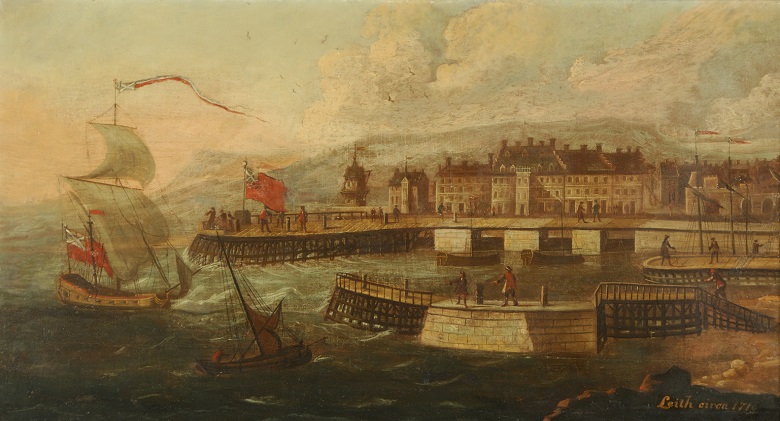
Painting of the Port of Leith, 1710.
Little thought appears to have been given to recruiting individuals with the skills required to establish and defend a new settlement, and no-one who volunteered discovered the actual destination until they had departed Scotland.
Sailing from Leith meant the fleet were required to travel north up and around Scotland before crossing the Atlantic. They didn’t reach Darien until the November, and things quickly began to fall apart. There had been several deaths on board during the journey, and many that survived were weak from months at sea and malnourishment.
Much of the landscape was impenetrable. This hindered efforts to build the settlement. Fierce tides made navigating in and out of the harbour hazardous and the supplies they’d brought from Scotland were running low. An attempt by one of the ships to collect much needed supplies in the West Indies ended with the crew being imprisoned by neighbouring Spanish colonists.
Isolation and abandonment
The Scots had brought a range of goods for trading with them, including wool, bibles, and hat pins. These had no value to the indigenous population, but it was hoped that they could be exchanged with the surrounding colonies.
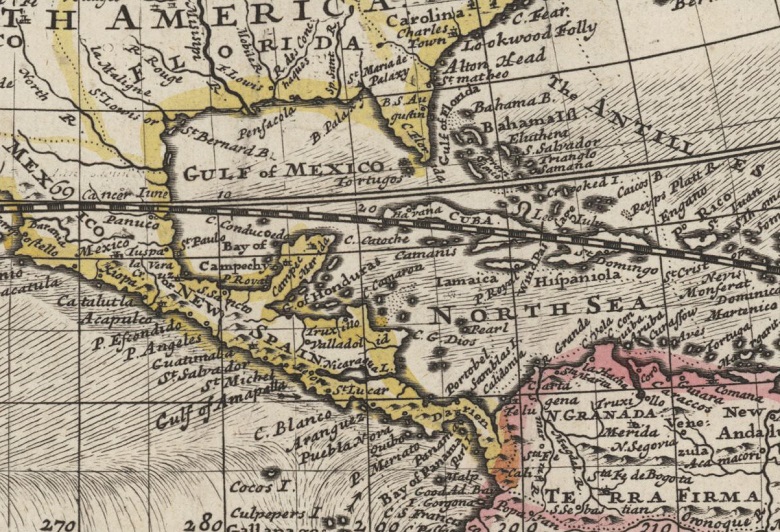
A 1732 map showing the location of Darien. Note the annotation of ‘Calidonia’ remains decades after the failed scheme. © A New and Correct Map of the World: Moll, Herman. Reproduced with the permission of the National Library of Scotland.
These hopes were dashed in May 1699 when it was discovered that William III had issued instruction that no English colony in the West Indies or North America was to trade with or support the Scottish settlers. Darien and the surrounding areas had already been claimed by Spain as part of their empire. The arrival of the Scots had broken a peace treaty between William and King Carlos II of Spain. Prohibiting contact with the Scots was William’s way of assuring Spain they had acted without his knowledge or consent.
Defeated, the colonists abandoned the settlement the following month. Only one ship with a few hundred survivors – including William Paterson – made it back to Scotland.
Further expeditions
News of the colony’s abandonment was slow to reach Scotland. Two relief ships carrying supplies and 300 people had already left Leith. They arrived in Darien in August 1699. The colony was deserted and overgrown. They sailed for the nearest English port instead. A fire aboard one ship disrupted the journey. Everyone transferred to the remaining vessel. They eventually disembarked in Jamaica. Their fate afterwards is unknown.
When abandonment rumours eventually reached Scotland, they were dismissed as attempts to undermine the venture. In August 1699, another major expedition of four ships and 1300 people departed, this time from the Clyde, meaning a shorter journey. The setbacks began immediately. The group were forced to anchor at Rothesay on Bute for a month to wait for a favourable wind. Around 160 people had died by the time they reached Darien on 30th November, St Andrews Day.
Work began on rebuilding a fort constructed by the original Scots colonists, but as with the first expedition, death, disease and depleting supplies became a serious problem. The neighbouring Spanish colonists were also planning an attack. Several skirmishes took place, which eventually saw the Scots cut off from access to the water supply. A deal was eventually struck, and the Scots were given two weeks to pack up their things and leave. They departed in April 1700 and arrived in Jamaica the following month. By August, news of the final abandonment of Darien reached Edinburgh.
Aftermath
Overall, fourteen Darien Company ships – a mix of expedition and relief vessels – sailed to Darien. Exact numbers are unknown, but of the approximately 2,800 people believed to have sailed, one contemporary source estimated that around 2,000 perished either at sea or on land. An enormous amount of money had been lost, and Scotland’s economy was devastated.
In the immediate years that followed, there was widespread resentment towards the Crown and English Parliament. One of the most hostile incidents took place in 1705. An English ship was forced to dock in the Firth of Forth after developing a leak. Authorities claimed that its captain had attacked a Darien Company vessel three years earlier. Despite little evidence, three members of the crew were executed at Leith Sands.
Darien and the Act of Union
The disaster in Darien is often cited as one of the reasons for the 1707 Act of Union between England and Scotland. There were benefits for both sides. For the English, it would alleviate fears of Scotland breaking away from the Union of the Crowns and potentially seeking an alliance with the French. For Scotland, it would allow for free trade with England and access to the substantial English colonial markets. There was also the promise of a large sum of money being sent north of the border, much of which was earmarked for Company of Scotland shareholders. Not only would people recuperate the original amount they invested, but they would also receive interest.
The United Kingdom came into existence on 1 May 1707, marking the dissolution of the Darien Company. The promised funds reached Edinburgh in August. William Paterson was one of the individuals tasked with calculating what the payment sum to Scotland should be. Remarkably, despite never investing in the company, he sought a share of the money received, though he was initally unsuccessful. He later became involved in the South Sea Company, another joint stock company with colonial pursuits. He died in 1719 and is buried at Sweetheart Abbey.
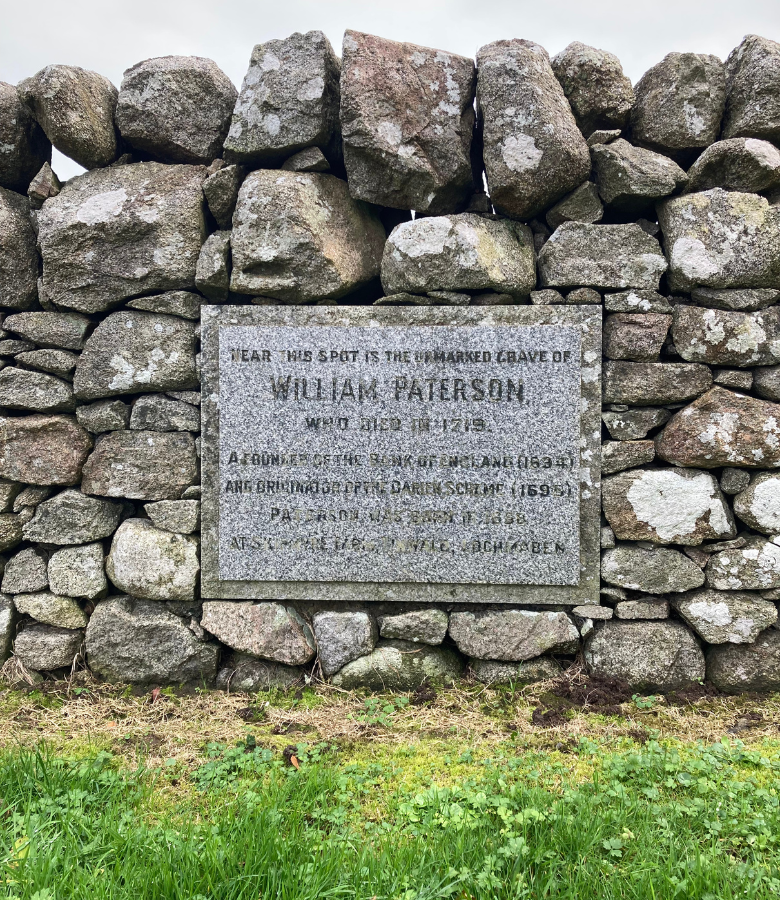
William Paterson’s memorial at Sweetheart Abbey.
A colonial venture
The Darien Scheme is often remembered as a national disaster for Scotland. Thousands of lives were lost and many investors saw their savings disappear. However, it is important to recognise that the scheme was also a colonial venture. By the late seventeenth century, the region already formed part of Spain’s American empire, and Indigenous communities were experiencing the effects of colonial expansion. Had the Scottish colony succeeded, it would likely have become another part of that wider process of European settlement, competition and exploitation.
Like many trading and colonial enterprises of the period, the scheme was driven by ambitions for wealth, territory and participation in global trade networks. These networks increasingly depended on the exploitation of colonised peoples and the transatlantic slave trade. While the Darien colony failed, many Scots later played significant roles in the expansion of the British Empire, including industries that profited from enslaved African labour in the Caribbean and the Americas.
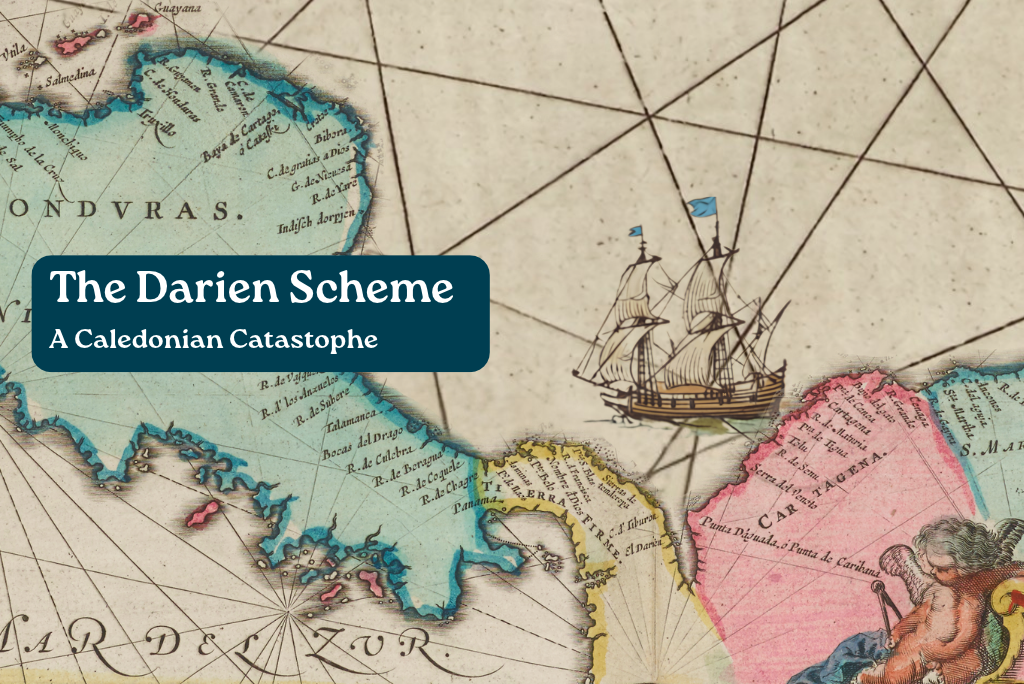
Banner image credit: Images of the map and ship in the banner are taken from the Blaeu Atlas Maior © Insvlæ Americanæ In Oceano Septentrionall; Blaeu, Willem Janszoon. Reproduced with the permission of the National Library of Scotland.
Share
About Author
