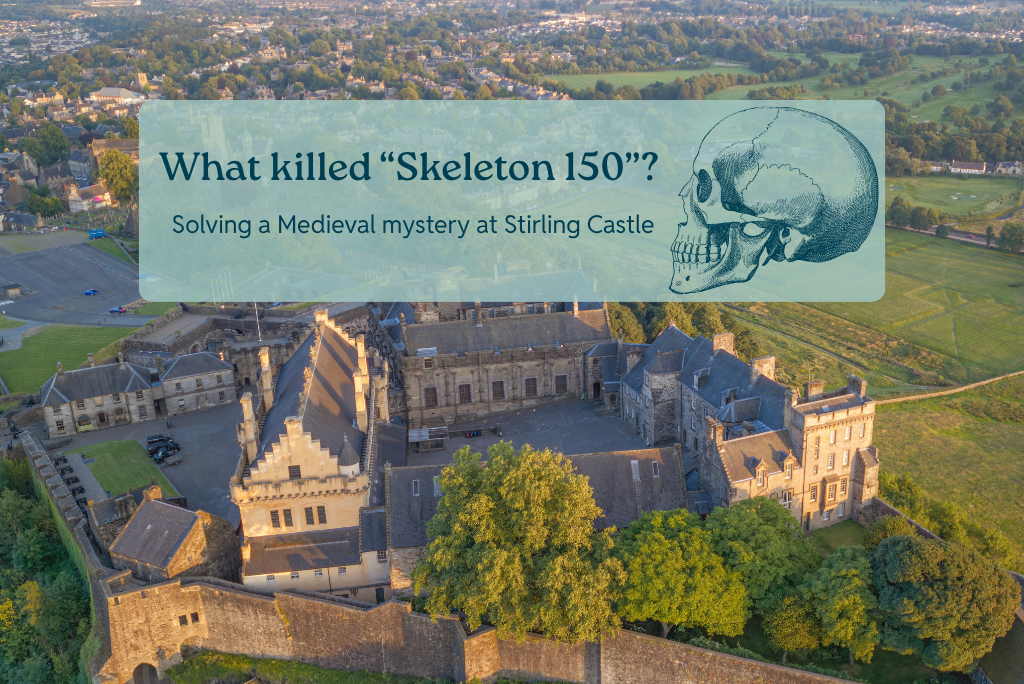
Back in 2009, Dr Jo Buckberry was asked for their expert opinion about a strange rectangular hole in the skull of a skeleton from Stirling Castle. In the 17 years since, we’ve learned much more about these remains. Below Jo tells the story of what we’ve uncovered about them, and the techniques used to unravel their mystery.
Please Note⚠️
This post contains images of human remains. Reader discretion is advised.
The skeletons beneath the castle chapel
In 1997 excavations in the building now known as the Governor’s Kitchen at Stirling Castle uncovered nine skeletons at varying levels of completeness. The burials were buried in a Christian manner. They were laid on their back and west east aligned with the head at the west end of the grave. Gordon Ewart, Kirkdale Archaeology, who excavated the skeletons, believes this building was an early chapel. The first references to a chapel at the castle date to the 12th century. This building pre-dated the Chapel Royal and was occasionally used for burial until the 14th century, although at least one burial took place in the 16th century.
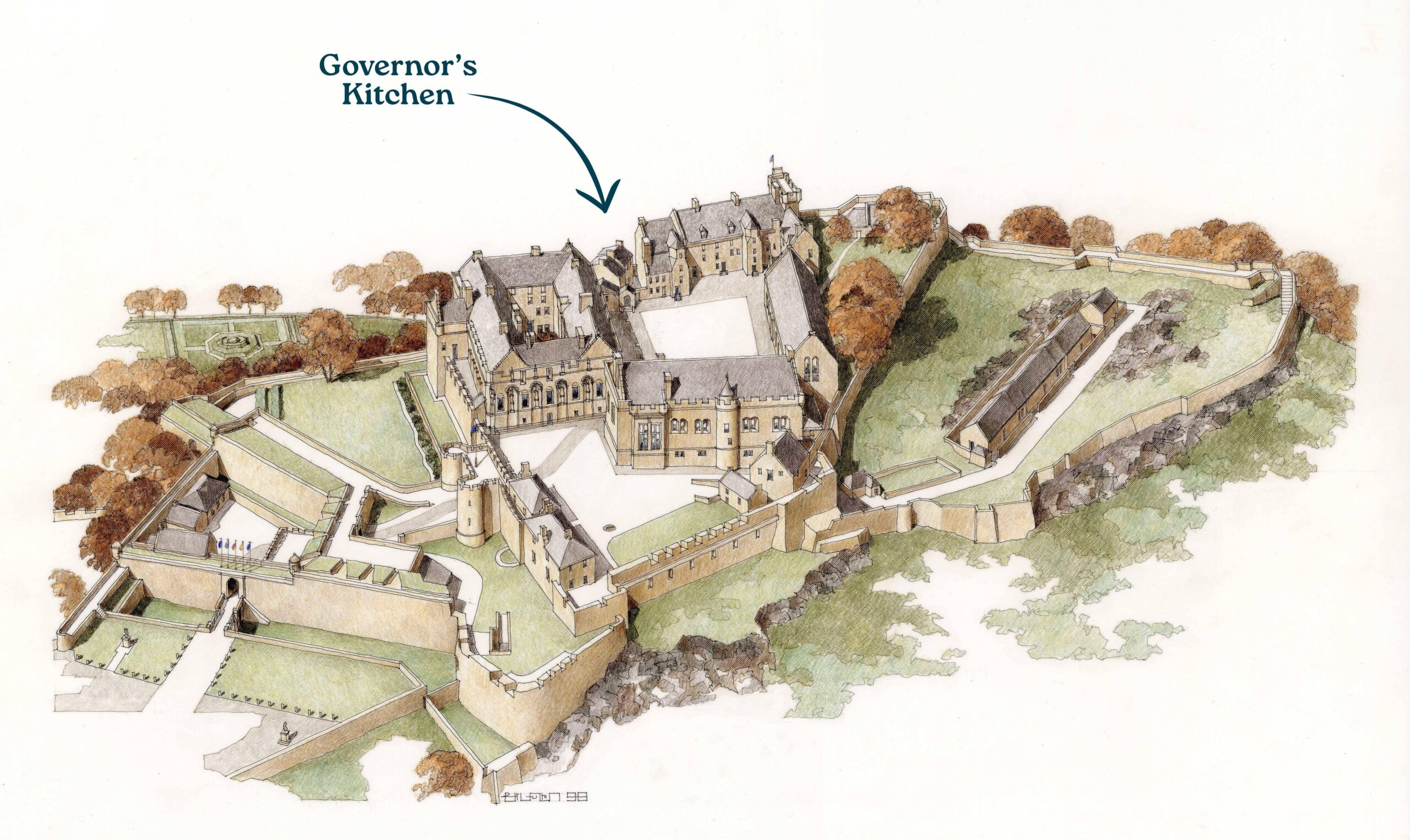
An aerial drawing showing the plan and layout of Stirling Castle. Illustration by Bill Fulton.
The remains were analysed by Nicola Battley shortly after the excavation for the future publication of Stirling Castle excavations. HES first contacted me (Jo) to offer a second opinion about two rectangular holes in the cranium of Skeleton 539. Nicola’s original analysis concluded that the cause of the unusual rectangular holes remained uncertain. She noted similarities with injuries seen on individuals from the Battle of Towton. She also considered whether they could represent a rare form of trepanation. This was an ancient surgical practice that involved drilling, cutting, or scraping a hole into the human skull. However, there was no evidence of the cut marks normally associated with a deliberate surgical procedure. Neither explanation could be confirmed.
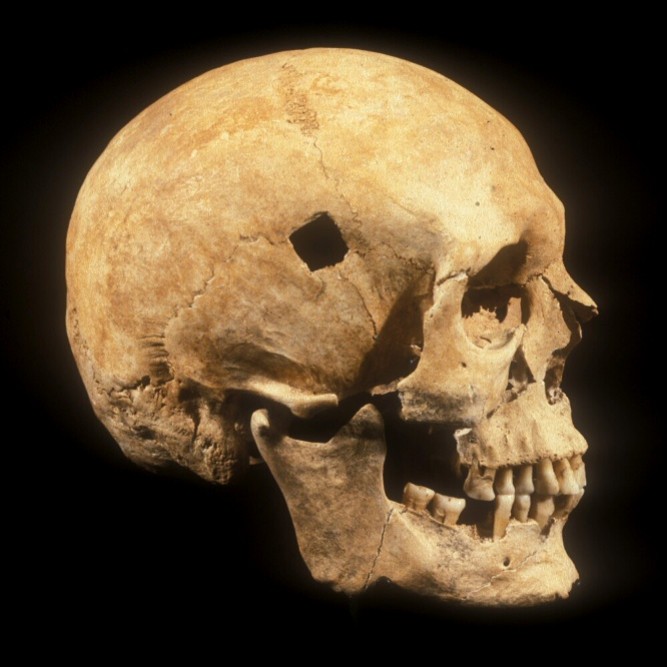
Square injury to skull of Towton 9 © University of Bradford
She was right – the holes are very similar to those on individuals from the Battle of Towton. Those remains are curated by the University of Bradford, and really do not look like square cut trepanation.
Advances in forensic archaeology
Over the last 30 years our understanding of peri-mortem injuries (those that happen around the time of death) have improved vastly. Examination of forensic cases, clinical literature and modern CT scans allows us to compare patterns of trauma caused in different ways. We can also use experimental archaeology – using replica weapons on animal bones or synthetic bone. Through this we can explore how variation in how a weapon is used can alter the appearance of trauma, as well as the examine the appearance of injuries caused by different weapons.
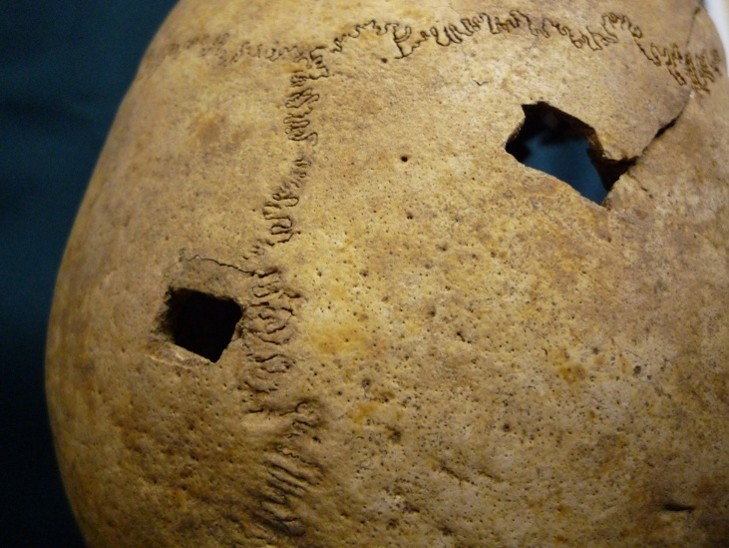
Rectangular injuries to skull of Stirling Castle Skeleton 539 © Jo Buckberry
What trauma can tell us
I reanalysed the skeletons in 2011-2012, building on Nicola’s first analysis. A joint report was published in ‘With Thy Towers High’ in 2015. I identified further peri-mortem injuries to five different skeletons, almost all caused by blunt force trauma – basically bone breaking after being hit by (or falling onto) something with a large surface area. This could be anything from a car crash to tripping over on ice, and includes many weapons as well as fists and feet. There were just three individuals with injuries that could be attributed to weaponry. These were the two rectangular holes on the skull of Skeleton 539 that started my research, a small cut mark to a rib of Skeleton 190, (almost certainly a stab injury from the tip of a knife), and a healed blade injury to the forehead of Skeleton 148.
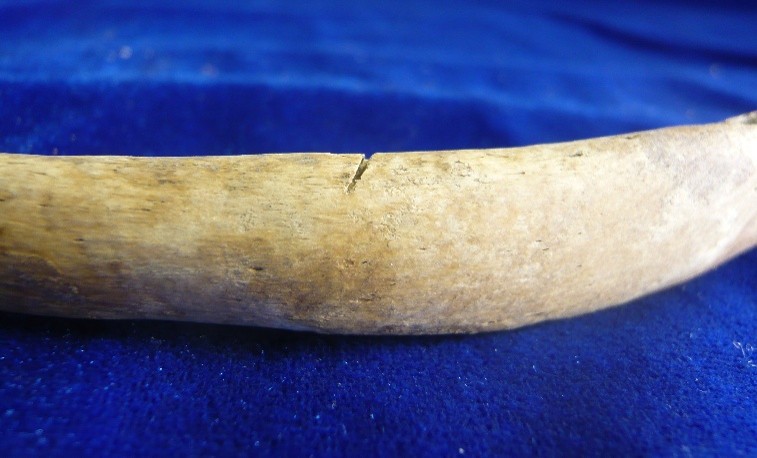
Stab injury to left rib Stirling Castle Skeleton 190 © Jo Buckberry
The pattern of peri-mortem blunt force trauma seen at Stirling Castle is unusual in medieval skeletons. Their burial location inside a castle chapel instead of a parish church is also unusual. The skeletons were very different to the medieval battle victims I have seen. There, the injuries seen are predominantly sharp force trauma, caused by swords and axes. Combining all of the information – the blunt force trauma, injuries from weapons, possible evidence of scurvy on two individuals, and the unusual burial location – with historical accounts about the Scottish Wars of Independence strongly suggested these individuals died during a siege.
The case of Skeleton 150
The injuries to Skeleton 150 were beyond anything I’d seen before. The many bioarchaeologists and forensic anthropologists I’d shown photos to felt the same. The left humerus (arm bone beneath the shoulder) had a huge zig zagged fracture. Zig zag fractures were also present on multiple ribs and both shoulder blades. The distribution of fractures was also unusual. He had injuries from the top of his head to his knees, including at least one to every single rib. Initially I recorded between 82 and 104 peri-mortem fractures to Skeleton 150.
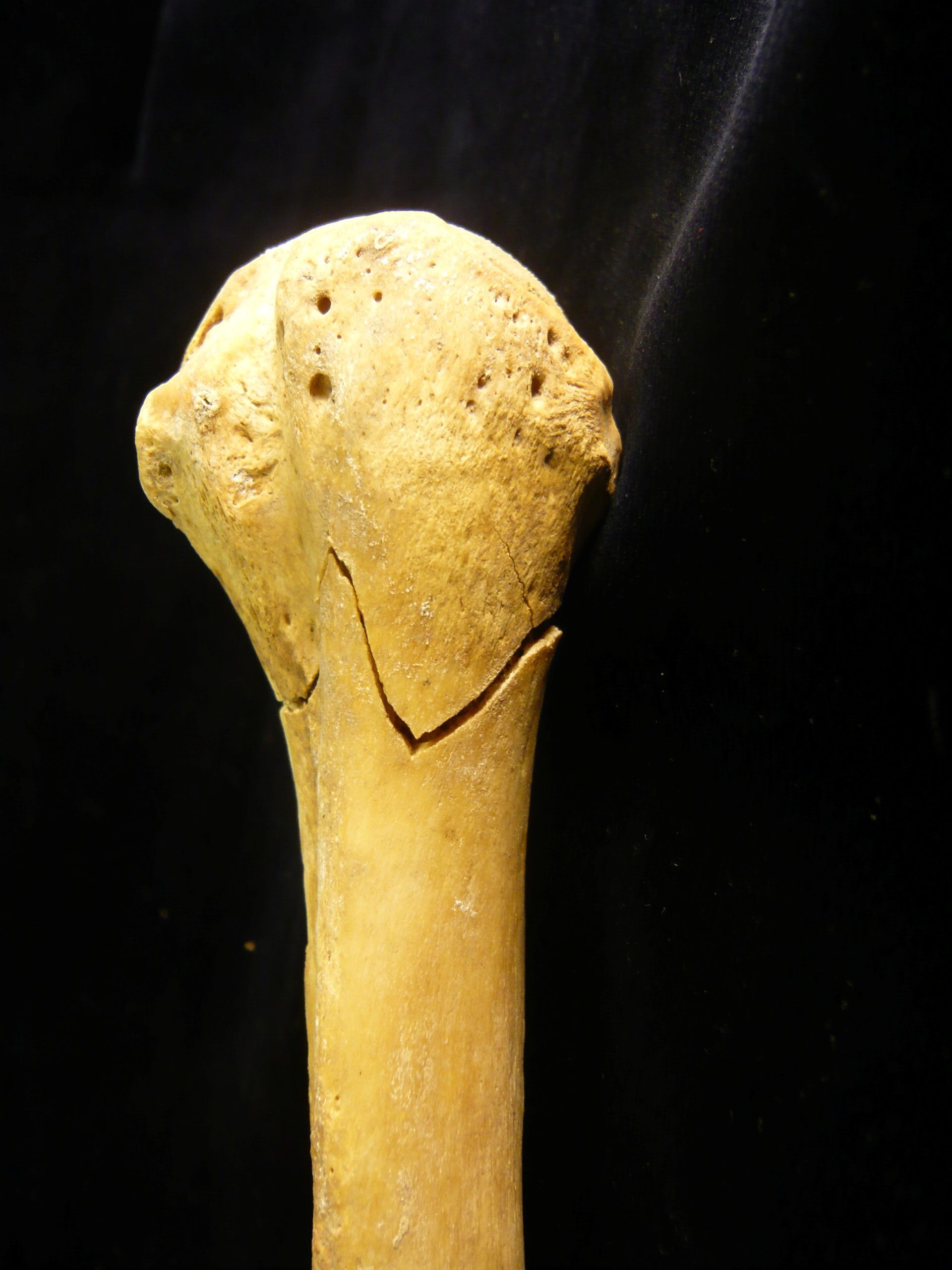
Deep zigzag fracture to the left humerus (upper arm bone) of Skeleton 150 © Jo Buckberry
The uncertainly was where I needed more detailed imaging to confirm if these were peri-mortem or if they had occurred shortly after death. These could have been fractures that occurred while buried but when the bone could still bend. Or perhaps they happened before death, but later on, in the grave, the edges of the breaks were damaged or scraped. There were many smaller breaks – hairline cracks in the skull, tiny fragments of thin bones. In these cases it was hard to tell if they occurred peri-mortem without further analysis and imaging.
Our initial assessment of Skeleton 150 in 2016 revealed that the injuries were clearly the result of blunt force trauma. The sheer number and wide distribution of fractures across his body indicates he suffered a particularly brutal death. However the pattern of fractures did not reveal if this was accidental or deliberate. Possibilities included falling from a great height, being crushed (for example, by falling masonry), being trampled (for example, by horses in a battle), being stoned, or being severely beaten/kicked. It led several possible scenarios open for further investigation (see Buckberry and Battley 2016: 52).
Rebuilding the evidence
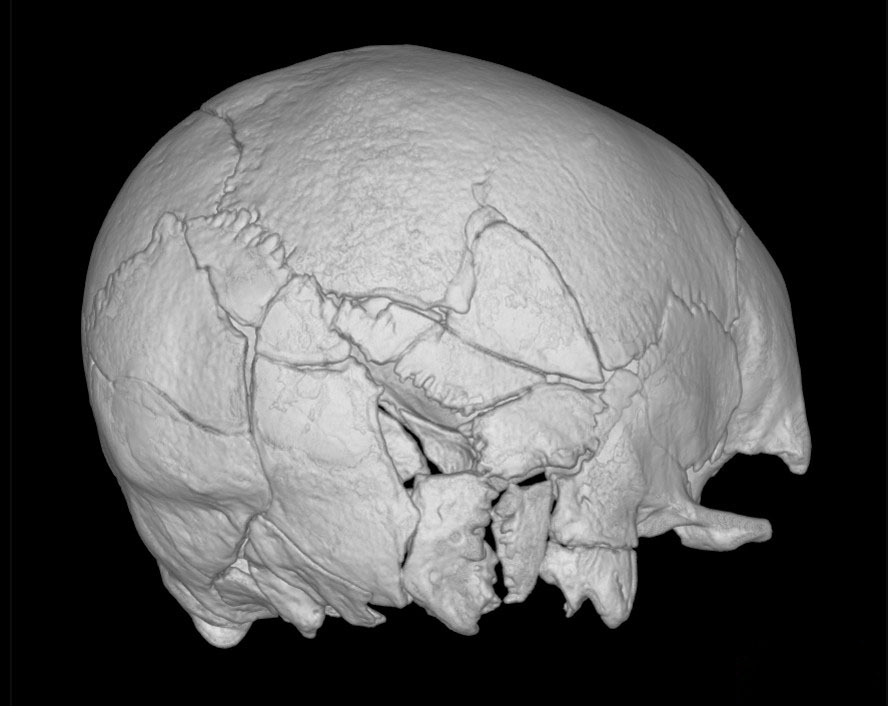
3D model from CT scan of reconstructed skull of Skeleton 150 © Jo Buckberry
There was clearly more research required, and so the 10-year quest for answers began! This involved research trips to examine forensic trauma cases of individuals of known cause of death. I also asked my colleague Dr Patrick Randolph-Quinney from Uppsala University to join the project. We carefully re-examined every single bone surface, increasing the total number of fractures to over 160. The very fragmented bones (cranium, right humerus and right femur) were carefully reconstructed using low adhesive tape. We then CT scanned them at the University of Bradford to create a digital 3D model. There is ongoing work to align this better. We have detailed records of the shape of every fragment and how they fit together, but even then, piecing the skull back together can take the best part of a day. Having the model is really useful!
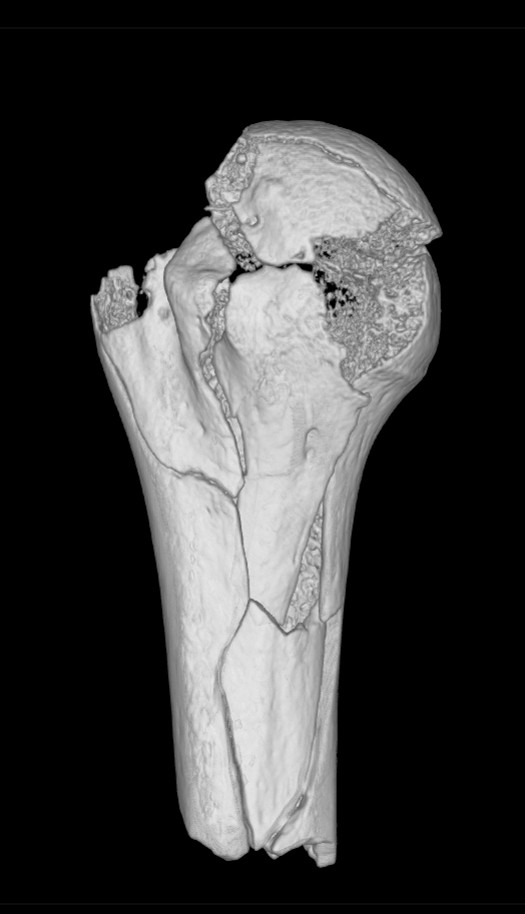
3D model from CT scan of reconstructed right humerus (through and beneath the shoulder) of Skeleton 150 © Jo Buckberry
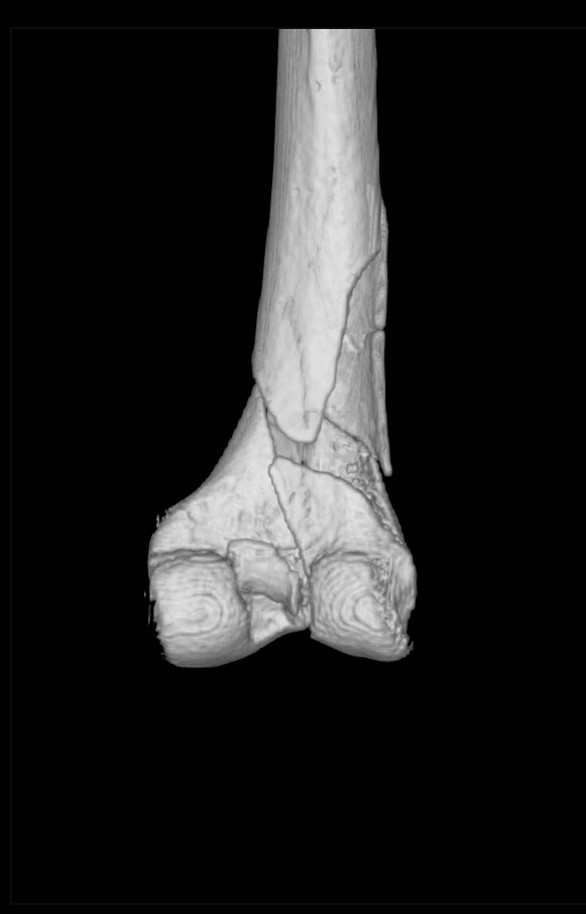
3D model from CT scan of reconstructed right distal femur (around and above the knee) of Skeleton 150 © Jo Buckberry
Following the fractures
We had to draw on our knowledge of soft tissue anatomy, complex forensic fracture analysis and bone biomechanics. We noted the direction of failure of each fracture where this was possible. This meant finding the path or orientation along which the bone had broken when subjected to stress. We considered how bone fractures when an individual is weight bearing (i.e. standing) versus not. Bone first breaks under tension, and this is on the opposite side of the bone to where the force is applied. We use this principle to work out directions.
The force that fractured his right ulna came from the front of the bone – this would be next to his body if his arm was hanging down. But it would be facing his chest if the elbow was bent and his forearm was in front of his body. The directionality of the fracture makes more sense if his body was in that position. The spiral fracture to his right femur suggested he was weight bearing (i.e. standing) and the leg twisted when that fracture occurred.
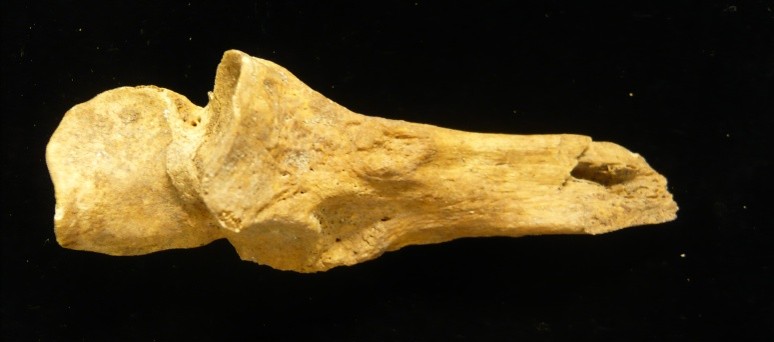
Fracture to right ulna (forearm) of Skeleton 150 © Jo Buckberry
Our searches through the forensic data all pointed towards a high-velocity impact. The nearest parallels to those zig zag fractures were in people who died in high-speed accidents or fell from a great height with nothing to interrupt their fall (one example fell 27m). This clearly wasn’t someone who was beaten up, trampled by horses or was tortured. Obviously, we can rule out cars, trains and planes in medieval Scotland! While he could have fallen from the castle walls, his body would have multiple impacts on the walls and then the rocky outcrop it sits on, each breaking his fall and reducing the velocity. While this might explain the distribution of fractures it doesn’t explain his fracture pattern.
Warfare and the War Wolf
So what was moving very fast in the Middle Ages? Here the historical evidence really helps. We know that Stirling Castle was besieged multiple times, and that in 1304 siege engines were deployed. We know that one of these was the Warwolf, the siege engine built by Edward I to force the castle garrison to surrender. It was used to devastating effect even after that surrender, cutting through 2 walls of the castle.
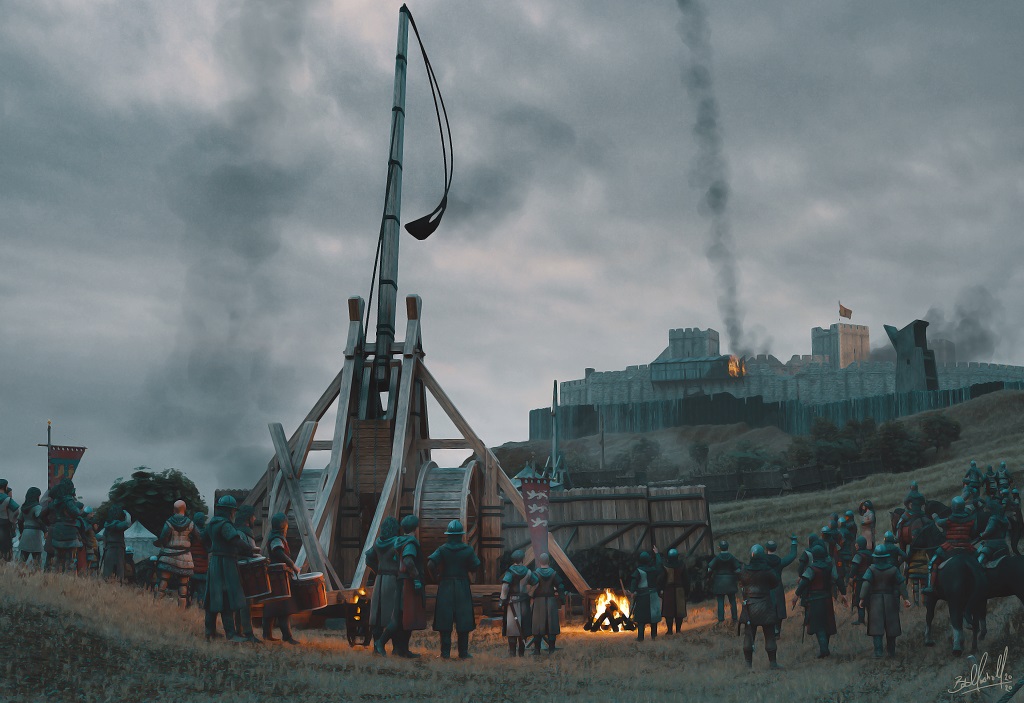
Bob Marshall’s interpretation of the War Wolf.
While mangonels (another medieval catapult style siege engine) were also used to throw large weights, these did not have the counterweight system which defines a trebuchet. They were unlikely to have been able to throw something sufficiently large to create damage that covered a grown man’s back. It’s most likely that the trauma to Skeleton 150 was caused by a large rock thrown by a trebuchet. The injuries to Skeleton 150 were so extensive, and were delivered with such velocity that we believe he was killed by a direct hit. If he was hit by falling masonry, the castle walls would slow the momentum of the forces.
The limits of certainty
Of course, we cannot say for certain this was in 1304. His radiocarbon date was recently recalibrated by my colleague Dr Cathy Batt. This takes into account the effect his diet would have on the carbon isotopes in his body, and also the stratigraphic relationship between the different burials in the chapel. This tells us he died somewhere between 1255 and 1405 (at 95% confidence). This is an annoyingly wide but scientifically accurate 150-year interval.
During this time, Stirling Castle was besieged four times – in 1299, 1304, 1314 and 1337. While we know at least one trebuchet was used in 1304, we don’t know if they were used in the other sieges. Whenever he died, the injuries he sustained would have thankfully killed him instantly. But his death will have been traumatic for the people in the castle, especially those tasked with burying his battered and bruised body, with ceremony, in the castle chapel.
Discover more
Interested in archaeology? Read more about Scottish archaeology on our blog, from Orkney to Edinburgh. You can also find more fascinating stories from Stirling Castle.
About the author
Dr Jo Buckberry is a human bioarchaeologist at the University of Bradford, specialising in the study of disease, and in particular evidence of violence on skeletal remains.
Header image photo credit: Thomas Lamont
Share
About Author